
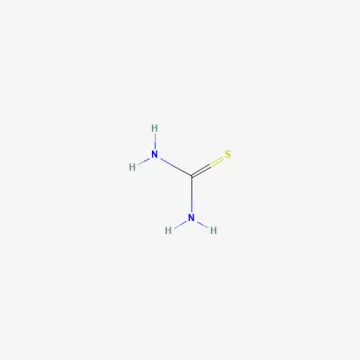
Thiourea
Description
Mode of action
Thiourea (thiocarbamide) is an organosulfur compound that functions primarily as a plant growth regulator and metabolic stimulant. It is widely recognized for its ability to influence plant physiological processes by modulating enzymatic activities.
The core mechanism involves the regulation of key enzymes associated with nitrogen metabolism and the alteration of endogenous hormone levels, which helps in mobilizing energy reserves stored within seeds and buds.
By stimulating respiratory pathways, thiourea effectively breaks physiological and deep dormancy in seeds and buds, facilitating a transition into active growth phases under controlled conditions.
The compound also acts as a stabilizer of protein synthesis, which indirectly enhances the plant's structural integrity and its physiological resistance against various abiotic stress factors.
Its molecular structure allows it to penetrate plant tissues easily, making it an efficient agent for rapid physiological response when applied to seeds or buds during the early stages of development.
What it targets
Thiourea is primarily used to improve the germination rate of seeds that are difficult to propagate or those that possess physical or physiological dormancy mechanisms.
In viticulture and pomology, it is an essential tool for breaking bud dormancy in vines and fruit trees, ensuring uniform bud break and synchronous flowering across the orchard.
The substance is also utilized in potato cultivation to stimulate the sprouting of tubers, which is particularly beneficial when early planting is required to maximize yield and market timing.
It serves as a rescue treatment for crops that have experienced periods of prolonged dormancy due to environmental constraints, helping to reactivate metabolic pathways.
- Seeds of recalcitrant plant species
- Grapevine buds before the growing season
- Seed potatoes to stimulate sprouting
- Fruit tree buds requiring synchronized awakening
Rates and timing
Application rates of thiourea are highly concentration-dependent and must be strictly monitored to prevent phytotoxicity. Typically, solutions ranging from 0.5% to 2% are used depending on the crop sensitivity.
For seed treatment, precise immersion times are required, followed by thorough washing with fresh water to remove excess residues before planting in the growing medium.
When applied to perennial crops, treatments should be performed early in the season, specifically before the initiation of sap flow, to avoid damaging developing tissues.
Ambient conditions during application should be moderate; avoiding peak sunlight and extreme heat is essential to maintain the stability of the compound and prevent leaf burn.
Exceeding recommended concentrations must be avoided at all costs, as higher doses can lead to growth inhibition, severe tissue necrosis, and loss of plant vigor.
Restrictions
Thiourea requires careful handling as it poses potential toxicity risks; therefore, the use of appropriate personal protective equipment, including gloves and respiratory protection, is mandatory.
As an environmentally active agent, it should be kept away from water sources to prevent contamination of aquatic ecosystems, as it may be harmful to various hydrobionts.
Storage should be in a cool, dry, and dark place, inside tightly sealed containers, ensuring it remains inaccessible to unauthorized persons, children, and pets.
Chemical compatibility is a critical issue; thiourea should not be mixed with oxidizing agents or strong acids unless specifically authorized, to avoid hazardous or ineffective chemical reactions.
Users should always conduct small-scale trials before widespread application to verify the crop-specific response, as physiological sensitivity to thiourea can vary significantly between varieties.
Status in the European Union
Not approved in the EU
- CAS number
- 62-56-6
- Category (EU)
- RO - Rodenticide
EU status is for reference only and does not replace national registration in your country.