

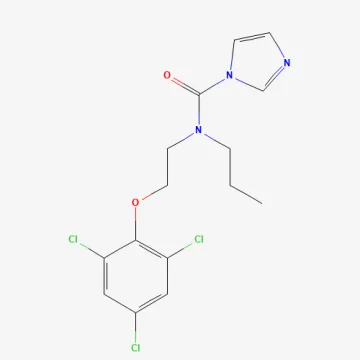
Description
Mode of action
Prochloraz is a member of the imidazole chemical class. It acts as a contact and translaminar fungicide, providing effective management of a wide range of fungal pathogens that attack various parts of agricultural plants.
The primary mechanism of action is the inhibition of ergosterol biosynthesis. Ergosterol is a vital component of fungal cell membranes, and its depletion causes structural defects, leading to membrane leakage and the ultimate death of the fungus.
Due to its high lipophilicity, prochloraz demonstrates excellent adhesion to plant surfaces, effectively penetrating the waxy layers of leaves and the seed coats of cereal grains to establish a long-lasting protective shield.
Unlike some highly mobile systemic fungicides, prochloraz does not move significantly through the vascular system of the plant, necessitating thorough coverage during application to ensure effective control of the targeted diseases.
The substance remains effective under a variety of environmental conditions, including cooler temperatures in early spring, which makes it a preferred choice for the initial stages of cereal protection programs.
What it targets
This active substance is widely used to combat complex fungal infections including leaf spots, stem bases diseases, and ear rot. It is particularly valued for its role in maintaining yield quality.
- Septoria leaf blotch and glume blotch.
- Fusarium head blight in cereals.
- Powdery mildew and eyespot disease.
- Anthracnose and Alternaria leaf spots in vegetables.
- Sclerotinia and Phoma in oilseed rape.
Prochloraz is highly effective at preventing the development of stem-base rots, which are a major cause of crop lodging in wheat and barley, thereby protecting the overall harvest integrity.
In fruit production, the fungicide is frequently utilized to prevent apple scab and various storage rots, ensuring the longevity and marketability of the harvested produce after it is placed in storage.
When applied as a seed treatment, it protects germinating crops against seed-borne and soil-borne pathogens, leading to improved stand establishment and healthier early plant growth.
Rates and timing
The recommended application rates for prochloraz range from 0.5 to 1.5 liters per hectare, depending on the crop type, disease pressure, and the specific formulation of the product used.
For seed treatment applications, precise dosage is essential to achieve a uniform coating of the seed surface without adversely affecting the germination process or the plant's initial development.
The optimal timing for field applications typically aligns with the critical stages of crop development, such as the stem elongation phase or early flowering, to mitigate the peak risk of pathogen infection.
To avoid potential crop stress or reduced performance, it is advised to avoid application during extreme heat or high-intensity sunlight, which can impact the stability and uptake of the fungicide.
Consistent monitoring of disease development in the field helps in scheduling applications efficiently, ensuring the fungicide is applied at the point of maximum biological impact.
Restrictions
Safety protocols must be strictly followed when handling prochloraz, including the use of adequate personal protective equipment to prevent skin contact and inhalation of spray mists.
To manage the risk of fungicide resistance, it is critical to implement integrated pest management strategies, including the rotation of prochloraz with chemicals belonging to different modes of action.
The product poses risks to aquatic organisms; therefore, rigorous precautions must be taken to prevent spray drift or runoff into nearby ponds, streams, or sensitive ecological zones.
Storage should be conducted in well-ventilated, secure areas, ensuring that the product remains in its original container and is protected from freezing, direct sunlight, and extreme temperatures.
Farmers must strictly adhere to the pre-harvest interval (PHI) specified on the product label to ensure that residues in the food supply are within safety regulations and human health standards.
Regulatory
Status in the European Union
Not approved in the EU
- CAS number
- 67747-09-5
- Category (EU)
- FU - Fungicide
- Approved from
- 01.01.2012
- Approval until
- 31.12.2021
- ADI
- 0.01 mg/kg bw/day
- ARfD
- 0.025 mg/kg bw
- AOEL
- 0.02 mg/kg bw/day
Hazard classification (CLP)
Acute Tox. 4 - H302Aquatic Acute 1 - H400Aquatic Chronic 1 - H410
EU legislation
EU status is for reference only and does not replace national registration in your country.
Content graph
Connections · Prochloraz
Most often together:
Marketplace
Products · 60


