

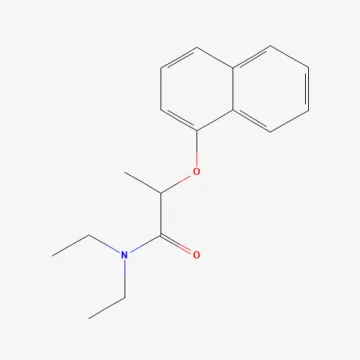
Description
Mode of action
Napropamide is a systemic herbicide belonging to the amide class, primarily used as a soil-applied treatment. It acts by preventing the growth of susceptible weeds during their early germination and emergence stages.
The mechanism of action involves the inhibition of cell division in the meristematic tissues of weed roots. Upon absorption through the root system, the active ingredient interferes with plant development, causing root arrest and subsequent plant death.
This herbicide exhibits high selectivity, allowing it to be safely applied to various crops without damaging the desired plants. It remains localized in the upper soil layers, creating a protective barrier against weed encroachment.
The efficacy of Napropamide is significantly dependent on soil moisture. Adequate water is required for the herbicide to dissolve into the soil solution and effectively reach the roots of the target weeds.
When applied correctly, it provides long-term protection, ensuring that the crop can establish itself without severe competition from annual grasses and select broadleaf weeds during the critical early growth phase.
What it targets
Napropamide is primarily used for the control of annual grasses and some broadleaf weed species. It is a vital tool for farmers growing crops such as rapeseed, tobacco, tomatoes, and peppers.
The herbicide is particularly effective at targeting weeds that germinate from the upper 5 cm of the soil. It stops these weeds before they can establish a strong root system or emerge above the surface.
By effectively suppressing early weed pressure, Napropamide helps to optimize resource availability for the crops, leading to higher yields and better overall health of the planting.
It is often used in integrated weed management programs to target specific grasses that may have developed resistance to other common herbicide groups.
- Barnyard grass (Echinochloa crus-galli)
- Foxtails (Setaria spp.)
- Annual bluegrass (Poa annua)
- Lambsquarters (Chenopodium spp.)
Rates and timing
The application rate for Napropamide depends on soil texture, organic matter content, and the specific weed pressure expected. Higher dosages are typically required on heavy or high-organic matter soils.
Incorporation into the soil is mandatory for optimal results. The herbicide should be mechanically mixed into the top 2–5 cm of soil immediately after application to prevent UV degradation and ensure proper soil contact.
Timing is critical: the product must be applied before crop germination and weed emergence. Post-application soil disturbance should be avoided to maintain the integrity of the treated layer.
Calibration of application equipment is essential to ensure a uniform distribution of the herbicide across the field, preventing gaps in coverage where weeds could potentially establish.
It is recommended to follow local regulatory guidelines regarding maximum application rates to minimize environmental impact while maintaining desired weed control efficacy.
Restrictions
A primary limitation is the need for sufficient soil moisture. If conditions are extremely dry following application, the herbicide may not be activated properly, leading to reduced effectiveness.
Crop rotation restrictions must be strictly observed, as residues of Napropamide can persist in the soil and affect the germination or growth of sensitive rotational crops.
Deep cultivation after application is strongly discouraged, as it disrupts the chemical seal created by the herbicide, allowing untreated soil and new weed seeds to reach the surface.
Personal Protective Equipment (PPE) is necessary during handling and application to prevent skin or eye contact and inhalation of spray mist, ensuring safety for the operator.
Storage should be kept in original, tightly closed containers in a cool, dry, and well-ventilated area, away from fire hazards, direct sunlight, and potential water contamination sources.
Regulatory
Status in the European Union
Approved in the EU
- CAS number
- 15299-99-7
- Category (EU)
- HB - Herbicide
- Approved from
- 01.01.2011
- Approval until
- 31.03.2027
- ADI
- 0.3 mg/kg bw/day
- ARfD
- Not appl.
- AOEL
- 0.5 mg/kg bw/day
EU status is for reference only and does not replace national registration in your country.
Content graph
Connections · Napropamide
Most often together:
Marketplace