

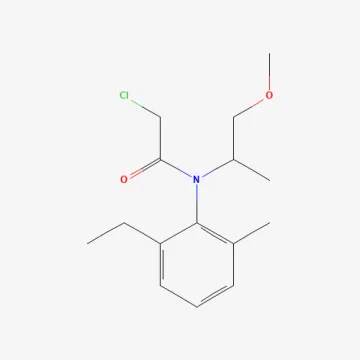
Description
Mode of action
Metolachlor belongs to the chloroacetanilide chemical class and acts as a highly effective systemic soil-applied herbicide. It is primarily absorbed by the hypocotyls and coleoptiles of germinating weed seeds.
The mechanism of action involves inhibiting protein synthesis and disrupting cell division processes. The substance affects biochemical pathways even before weeds emerge from the soil surface.
The chemical blocks enzymatic reactions necessary for forming cell membranes, leading to the death of the seedling at the white-thread stage. Activity is strictly targeted at actively growing weeds.
Metolachlor provides a long residual effect, which can last from 8 to 12 weeks depending on environmental conditions. Persistence in the soil ensures crop protection during the most vulnerable early development phases.
The substance does not translocate significantly within the plant after emergence, making the creation of a uniform protective barrier in the topsoil layer before germination crucial for success.
What it targets
This substance effectively suppresses most annual grass weeds and some broadleaf species. It is used to control competitive weeds that rapidly colonize space during the early vegetative period.
Primary target species include: foxtail species, barnyard grass, crabgrass, and certain amaranth species. The herbicide has limited impact on perennial weeds, as it is designed to kill seedlings emerging from seeds.
- Green and yellow foxtail
- Barnyard grass
- Large crabgrass
- Amaranth species (with partial control)
Successful weed control is only possible if soil moisture levels are adequate. Under dry conditions, efficacy against specific broadleaf species may be significantly reduced.
Agronomists recommend using Metolachlor as a foundation for integrated weed management programs, often combining it with other herbicides to broaden the spectrum of controlled broadleaf weeds.
Rates and timing
Application rates for Metolachlor are directly dependent on the soil texture and organic matter content. Heavy soils rich in organic matter require higher doses to achieve the desired level of weed suppression.
The herbicide can be applied pre-sowing with incorporation or post-sowing before crop emergence. Incorporation during pre-planting tillage is considered optimal to ensure even distribution within the topsoil layer.
When applying before crop emergence, it is necessary to maintain a fine-textured seedbed to form a continuous chemical barrier. Large soil clods reduce application quality and allow weeds to emerge through gaps.
Quality field preparation is a fundamental requirement. Soil must be sufficiently moist, as the herbicide requires moisture for activation and uptake by developing weed sprouts.
Re-entry intervals for mechanical work are regulated by local agricultural standards, typically ranging from 3 to 7 days. Application should be performed using calibrated equipment with properly functioning nozzles.
Restrictions
The primary constraint is phytotoxicity if application protocols are violated. Deep incorporation or excessive dosages in sandy soils can lead to significant stunting of the main crop.
Inter-row cultivation is prohibited for 10-14 days after herbicide application, as this breaks the protective soil layer and drastically reduces the substance's efficacy.
When selecting crop rotations, potential residual effects must be considered; however, when applied at label rates, Metolachlor usually degrades before the next season begins.
Use is not recommended on soils with very low organic matter, as this increases the risk of leaching the active ingredient into the root zone of the crop plants.
Strict adherence to personal protective equipment protocols is mandatory when handling the concentrate, including the use of chemical-resistant clothing, respirators, and gloves to prevent skin and eye contact.
Regulatory
Status in the European Union
Not approved in the EU
- CAS number
- 51218-45-2
- Category (EU)
- HB - Herbicide
EU legislation
EU status is for reference only and does not replace national registration in your country.
Content graph
Connections · Metolachlor
Most often together:
Marketplace
Products · 19


DoubleTry, CE, (Metolachlor, 960 g/l)
Agrochemical, LLC
Herbicides
0
0
·
55
3 offers
6.99 €per 1 l
Buy


Varyag
ТОВ «Фабрика агрохімікатів», Черкаси, Україна
Herbicides
0
0
·
36
29 offers
5.44 €per 1 l
Buy

VARYAG, KS (metolachlor, 315 g/l + terbuthylazine, 190 g/l)
ТОВ «Фабрика агрохімікатів», Черкаси, Україна
Herbicides
0
0
·
36
1 offer
158.8 €per pack
Buy

Avanguard EC
Санрайз Кемікалз Ко. Лтд., Шанхай, Китай
Herbicides
0
0
·
31
1 offer
10.57 €per 1 l
Buy

MTM-Old
ТОВ «Фабрика агрохімікатів», Черкаси, Україна
Herbicides
0
0
·
28
5 offers
1.43 €per pack
Buy


Dan-S
Superus Co., Ltd., Китай, Yangzhou Pioneer Chemical Co., Ltd., Китай
Herbicides
0
0
·
40
No offers
—
Details
