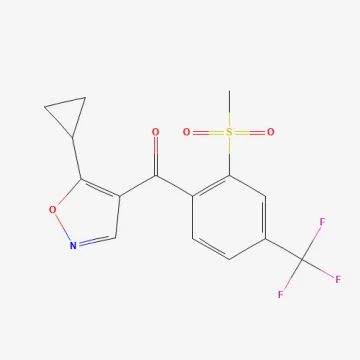
Description
Mode of action
Isoxaflutole belongs to the isoxazole chemical class and acts as a systemic herbicide. Its primary mechanism is the inhibition of the 4-hydroxyphenylpyruvate dioxygenase (HPPD) enzyme, which is crucial for carotenoid synthesis in plants.
Inhibition of this enzyme leads to the degradation of chlorophyll in susceptible plants, causing characteristic leaf bleaching. This process, often called bleaching, results in rapid weed death due to the cessation of photosynthesis.
The substance is known for its soil reactivation property. When rainfall occurs after a dry period, isoxaflutole can reactivate in the soil, providing activity against new flushes of weeds.
Systemic properties allow the active ingredient to be rapidly absorbed by the roots and shoots of germinating weeds, ensuring a long duration of residual activity and control over a broad range of weed species.
Due to its high selectivity, crops like corn are able to metabolize isoxaflutole into inactive compounds, ensuring the safety of the application when dosage guidelines are followed.
What it targets
Isoxaflutole is used to control a wide range of annual broad-leaved weeds and certain grasses in agricultural crop production.
It is particularly effective against problematic broad-leaved species such as common lambsquarters, pigweed, black nightshade, knotweed, and common ragweed.
It also provides suppressive effects on specific grass weed species, making it a comprehensive solution for soil-applied weed management.
The level of weed control depends on the organic matter content in the soil, soil moisture, and the weed species composition present in the specific field.
The product is most effective when applied at the initial stages of weed development, as weeds are highly susceptible to HPPD-inhibitor action during early germination.
Rates and timing
Application rates for the product depend directly on soil type, particularly organic matter content and soil texture, as well as the expected weed pressure on the field.
Isoxaflutole is typically applied as a pre-emergence treatment, immediately after sowing the crop and before its emergence.
Quality soil preparation prior to application is a critical requirement; the field surface should be fine-tilled without large clods to ensure uniform distribution of the active ingredient.
The optimal timing of application varies by climatic zone; however, it is essential to avoid dry soil conditions at the time of application to achieve maximum soil-based performance.
It is recommended to follow the manufacturer's specific guidelines regarding formulation, as some products may include safeners to improve crop selectivity.
Restrictions
Isoxaflutole is not recommended for use on soils with very low organic matter or on highly sandy soils due to the risk of leaching into the crop's root zone.
There are strict limitations regarding subsequent crops in the rotation; it is necessary to check crop rotation guidelines before planting winter cereals or other sensitive crops.
In case of reseeding a failed crop on a field treated with isoxaflutole, deep plowing must be performed to minimize the risk of phytotoxicity.
Application is prohibited during high wind speeds to prevent drift of the spray solution onto neighboring fields containing sensitive crops.
When handling the substance, personal protective equipment for respiration, skin, and eyes must be used in accordance with general safety requirements for working with pesticides.
Content graph
Connections · Isoxaflutole
Most often together:
Marketplace
Products · 9