

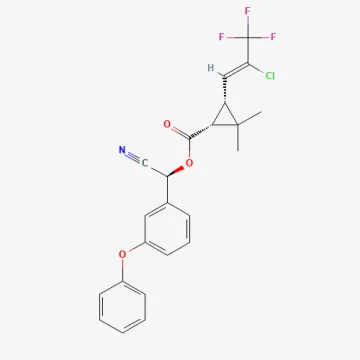
Description
Mode of action
Gamma-cyhalothrin belongs to the chemical class of second-generation synthetic pyrethroids. This active ingredient is a highly potent isomer of lambda-cyhalothrin, characterized by enhanced biological activity against a wide array of insect pests.
The mechanism of action is based on disrupting the nervous system of the target insects. It interferes with the sodium channels in nerve cell membranes, triggering continuous membrane depolarization and the disruption of nerve impulse transmission.
This disruption leads to the paralysis of the insects, followed by their death. The substance acts through both contact and ingestion, ensuring high efficacy even when the insect is only partially exposed to the treated surface.
Due to its high lipophilicity, gamma-cyhalothrin penetrates the insect cuticle rapidly. This property enables a quick "knock-down effect," causing the pests to cease feeding within minutes of the application.
In addition to its immediate insecticidal impact, gamma-cyhalothrin provides residual activity on plant surfaces. This creates a protective barrier that persists for a certain duration, offering extended protection against incoming pests.
What it targets
This active ingredient is designed to control a vast range of pests from various orders. It is highly effective against Lepidoptera (caterpillars, moths), Coleoptera (beetles, leaf-eating insects), Hemiptera (aphids, leafhoppers), and various other pests.
It is widely used in cereal crops to protect against pests such as cereal beetles, bugs, and thrips. Furthermore, it is a key component in the protection of corn against European corn borer and is extensively used in vegetable crops.
In orchards, gamma-cyhalothrin is utilized to manage codling moths and various species of leafrollers. Its broad spectrum makes it a reliable tool in modern Integrated Pest Management (IPM) systems.
The use of this insecticide helps mitigate damage caused by hidden pests that attack the generative organs of plants. By reducing pest pressure, it contributes to preserving crop yields and enhancing the quality of agricultural produce.
Applications are most effective during the stage of mass pest emergence or when larvae are in their early developmental instars, as they are most susceptible to the action of pyrethroid compounds at these stages.
Rates and timing
Application rates for gamma-cyhalothrin depend on the target pest and the crop being treated. Typically, rates range from 0.05 to 0.15 liters of product per hectare, depending on the active ingredient concentration of the specific formulation.
Applications should be carried out during the growing season when the economic threshold for pest presence is reached. Ensuring uniform coverage of the entire plant canopy is critical for achieving maximum biological efficacy.
The spray solution must be prepared immediately before application. The product should be mixed with water according to the manufacturer's recommendations, usually involving a spray volume of 200–400 liters per hectare for field crops.
It is not recommended to perform treatments during high air temperatures (above 25-28 degrees Celsius) or under intense sunlight. Early morning or evening hours are the best times for application to avoid active bee foraging periods.
To prevent the development of pest resistance, it is advised to rotate the use of gamma-cyhalothrin with insecticides from different chemical classes, ensuring diverse modes of action are applied throughout the season.
Restrictions
This substance is highly toxic to bees and other beneficial pollinating insects. Treatments during active crop flowering are strictly prohibited, and applications near apiaries must adhere to established protective buffer zones.
Gamma-cyhalothrin is hazardous to fish and aquatic organisms. It is strictly forbidden to allow spray drift or residues to enter water bodies, drainage canals, or sources of drinking water.
Operators must wear personal protective equipment, including respirators, protective clothing, gloves, and safety goggles. Strict adherence to personal hygiene protocols after handling the chemical is a mandatory safety requirement.
Pre-harvest intervals (PHI) must be strictly observed as per the regulatory labels for each specific crop. This interval typically ranges from 20 to 30 days, ensuring the safety of the final agricultural product for the consumer.
Products should be stored in specialized warehouse facilities under controlled temperature conditions, away from food, feed, and out of reach of children and domestic animals.
Regulatory
Status in the European Union
Not approved in the EU
- CAS number
- 76703-62-3
- Approved from
- 01.04.2015
- Approval until
- 31.03.2025
- ADI
- 0.0012 mg/kg bw/day
- ARfD
- 0.0025 mg/kg bw
- AOEL
- 0.0003 mg/kg bw/day
EU legislation
EU status is for reference only and does not replace national registration in your country.
Content graph
Connections · Gamma-cyhalothrin
Most often together:
Marketplace
Products · 5


Vantex 60, microencapsulated suspension (gamma-cyhalothrin, 60 g/l)
Доу АгроСайенсіс, Кінг’з-Лінн, Великобританія
Insecticides
0
0
·
39
2 offers
24.01 €per 1 l
Buy