

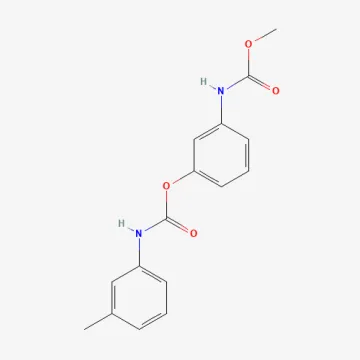
Description
Mode of action
Phenmedipham is a selective, contact-acting herbicide belonging to the phenylcarbamate chemical family, widely used in industrial crop protection.
The primary mode of action is the inhibition of photosynthesis by interfering with electron transport in photosystem II of target weeds.
Upon application, the substance is absorbed through the leaf foliage, leading to rapid yellowing and eventual death of the susceptible weed species.
Since phenmedipham exhibits limited systemic translocation, it relies heavily on the thorough wetting of the target plant's foliage for maximum efficacy.
The speed of herbicidal activity is closely linked to physiological conditions, with warmer, sunny weather generally accelerating the lethal impact on weeds.
What it targets
Phenmedipham is specifically formulated for the control of annual broadleaf weeds in sugar beet, fodder beet, and red beet fields.
It is particularly effective against species such as Chenopodium album (fat-hen), Amaranthus, and various Polygonum species during their early development.
The highest level of control is achieved when weeds are at the cotyledon stage, before they have developed a robust protective leaf layer.
The herbicide is often used in combination with other active ingredients to enhance the weed spectrum and manage difficult-to-control populations.
While effective on broadleaves, phenmedipham has little to no impact on grasses, necessitating complementary measures where grass infestation is high.
Rates and timing
The standard agronomic practice involves split applications, timed to target successive flushes of weeds throughout the early crop growth season.
Timing is critical: applications should be performed as soon as weed germination occurs to ensure the most vulnerable growth stage is reached.
Application rates are adjusted based on the specific formulation of the herbicide and the density of the weed canopy in the field.
Optimal results are achieved under conditions that allow for sufficient leaf uptake, avoiding rapid drying caused by extreme environmental factors.
Farmers are advised to follow strict adherence to the manufacturer's labeled rates to prevent crop stunting while ensuring maximum weed kill.
Restrictions
Crop safety is a priority; do not apply phenmedipham to beets experiencing physiological stress from drought, frost, or pest pressure.
Excessive heat during application may reduce efficacy and increase the risk of temporary leaf chlorosis on the protected beet crops.
Users must ensure that the equipment is properly calibrated to prevent spray drift onto non-target areas or sensitive adjacent crops.
Adhering to personal protective equipment protocols is mandatory when handling the concentrate or preparing the tank mixture.
- Check local regulations regarding water source contamination.
- Store the product in a cool, dry area away from food supplies.
- Dispose of containers according to regional environmental standards.
Content graph
Connections · Phenmedipham
Most often together:
Marketplace
Products · 154




Contactwin, c.e., (Fenmedifam, 97 g/l + Etofumezat, 94 g/l)
FineChemie iSchwebda GmbH, Germany, F. member of the group
Herbicides
0
0
·
49
No offers
—
Details


Briton, EC (ADG2/8)
Три Дельта Компані Інтернешнл, Гонконг, Китай.
Herbicides
0
0
·
48
No offers
—
Details


Good Harvest EFD, CE
Jiangsu Good Harvest-Wayen Agrochemical Co., Ltd.
Herbicides
0
0
·
44
No offers
—
Details

Triactiv c.e., (Fenmedifam, 91g/l + Desmedifam, 71g/l + Etofumezat, 112 g/l)
Jiang'an Agrin Company Ltd.
Herbicides
0
0
·
44
No offers
—
Details


Herbicide «VITALON EXPERT»
«Нанджин Ессенс Файн-Кемікал Ко. Лтд» (Китай)
Herbicides
0
0
·
41
No offers
—
Details


Medifam Ultra
«Шаньдунська хімічна компанія Чіачан» , Китай.
Herbicides
0
0
·
34
No offers
—
Details


