

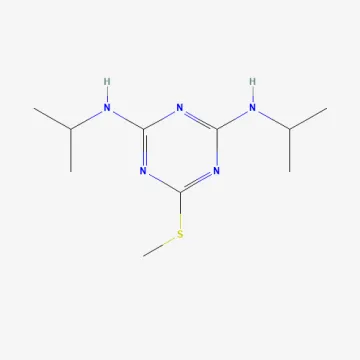
Description
Mode of action
Prometryn is a member of the symmetrical triazine chemical class, widely used as a systemic herbicide. It is primarily absorbed by the root system and seedlings of germinating weeds.
The mechanism of action involves the inhibition of photosynthesis in target plants. By blocking the Hill reaction, Prometryn disrupts electron transport, preventing energy production and causing the weed to wither and die.
This substance exhibits selective properties, allowing it to be used on specific crops like sunflowers, carrots, and peas that can safely metabolize the compound.
When applied to the soil, it creates a persistent protective barrier. This surface layer stops weed seeds from germinating and emerging, providing a long-lasting residual effect.
The efficacy of Prometryn is highly dependent on soil moisture. Adequate water content in the soil is necessary to activate the herbicide and ensure its mobility toward the weed roots.
What it targets
Prometryn is highly effective against a wide range of annual broad-leaved weeds and some annual grasses in their initial growth stages.
Key weed species controlled by this herbicide include common lambsquarters, pigweed, field mustard, shepherd's purse, and chickweed.
The compound also suppresses the growth of several other minor weed species that emerge simultaneously with the crop.
- Common lambsquarters (Chenopodium album)
- Redroot pigweed (Amaranthus retroflexus)
- Field mustard (Sinapis arvensis)
- Shepherd's purse (Capsella bursa-pastoris)
- Common chickweed (Stellaria media)
By eliminating these competitors early on, farmers can secure the initial growth phases of their crops and minimize yield losses caused by early-season weed interference.
Rates and timing
Prometryn is typically applied as a pre-emergence treatment, meaning it is sprayed onto the soil immediately after sowing but before the crop appears above the surface.
Application rates depend on soil texture and organic matter content. Soils with higher clay content usually require higher doses, while sandy soils require the lowest labeled rates.
Soil preparation is crucial for success. The field surface should be smooth and free of large clods to ensure a uniform distribution of the chemical across the field.
Operators must avoid overlap during application to prevent localized concentrations that could lead to crop phytotoxicity, especially in less tolerant varieties.
It is important to apply the herbicide when there is sufficient soil moisture or impending rainfall, as dry soil conditions significantly reduce the residual herbicidal activity.
Restrictions
Inter-row cultivation should be avoided shortly after the application of Prometryn. Mechanical disturbance of the soil destroys the chemical barrier and allows new weeds to emerge.
Using this herbicide on very sandy soils carries a risk of leaching into the root zone of the crop, which may cause stunted growth or damage to the plants.
Safety measures must be strictly followed. This includes using appropriate personal protective equipment (PPE) when handling the concentrate or preparing the tank mixture.
Crop rotation plans should take into account the residual activity of the substance. In areas with prolonged drought, extra care is advised before planting sensitive subsequent crops.
Strict environmental precautions must be taken to prevent runoff into aquatic ecosystems, as Prometryn can be harmful to fish and other aquatic organisms.
Content graph
Connections · Pre-tax
Most often together:
Marketplace
Products · 127


