
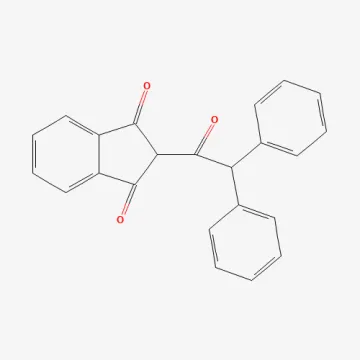
Diphacinone
Description
Mode of action
Diphacinone belongs to the indandione chemical class and acts as a second-generation anticoagulant rodenticide. Its primary mechanism of action involves the inhibition of vitamin K synthesis in the liver of warm-blooded animals.
By suppressing the enzymes responsible for vitamin K metabolism, the substance disrupts the production of blood clotting factors, leading to a critical decrease in blood coagulation ability.
The gradual accumulation of the compound in the rodent's body causes internal hemorrhaging, which eventually becomes uncontrollable. Death typically occurs from internal bleeding several days after the bait is consumed.
A key advantage of this mechanism is the lack of "bait shyness" in rodent populations. Because symptoms are delayed, animals do not associate the death of their peers with the consumption of the bait.
Diphacinone has a cumulative effect, requiring multiple feedings over several days to achieve a lethal dose, which ensures a high level of reliability in large-scale deratization programs.
What it targets
Diphacinone is primarily used to control synanthropic and field rodents, including Norway rats, roof rats, house mice, and various species of voles.
The substance is widely applied in agricultural settings, including warehouses, grain silos, livestock buildings, and surrounding areas where rodent activity poses a risk to stored goods.
In crop production, it is used for local control of rodent populations in fields, orchards, and shelterbelts to prevent damage to young crops and agricultural infrastructure.
It is effective against rodent populations that have developed resistance to first-generation anticoagulants due to its higher cumulative toxicity.
- Norway rats (Rattus norvegicus)
- Roof rats (Rattus rattus)
- House mice (Mus musculus)
- Voles (Microtus spp.)
Rates and timing
Diphacinone is typically formulated as ready-to-use baits, such as grain mixes, pellets, or wax blocks, with an active ingredient concentration of 0.005% to 0.01%.
Baits should be placed along known rodent runways, near burrow entrances, and inside protected stations along warehouse walls to keep them away from non-target species.
Application rates vary depending on the level of infestation. Typically, 20–50 grams of bait per station is used for mice, and 100–150 grams per station for rats.
Stations must be monitored regularly and replenished until feeding activity ceases, which indicates that the local population has been eliminated.
The best time for application corresponds with seasonal rodent migration patterns, usually in spring and autumn, when rodents actively seek food and shelter near storage facilities.
Restrictions
Safety is paramount; handlers must follow strict hygiene protocols, including washing hands after baiting and avoiding smoking or eating during the handling of the product.
To prevent accidental poisoning, bait stations must be secured or placed in areas inaccessible to children, pets, and wildlife.
In cases of accidental ingestion, Vitamin K1 (phytomenadione) serves as the primary medical antidote and must be administered under strict professional medical supervision.
Dead rodents should be disposed of by burial or incineration to prevent secondary poisoning of scavengers, such as raptors or farm dogs that might consume contaminated carcasses.
The product must be stored in its original, sealed container in a cool, dry, well-ventilated space, strictly separated from human food and livestock feed stocks.
Status in the European Union
Not approved in the EU
- CAS number
- 82-66-6
- Category (EU)
- RO - Rodenticide
EU status is for reference only and does not replace national registration in your country.