
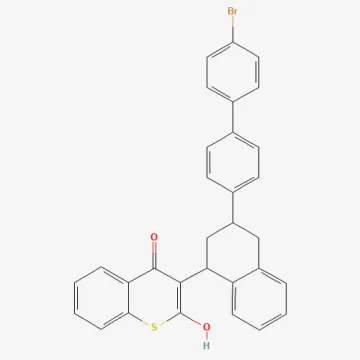
Difethialone
Description
Mode of action
Difethialone belongs to the second-generation anticoagulant chemical class. Unlike first-generation agents, it exhibits significantly higher biological activity, allowing for a lethal effect even after a single ingestion of the bait.
The mechanism of action involves blocking the vitamin K1 epoxide reductase enzyme. This disrupts the synthesis of blood clotting factors in the liver, leading to internal and external hemorrhaging in the pests.
A key advantage of difethialone is its delayed effect. Rodents do not associate the death of their colony members with the bait consumption, which prevents the development of bait shyness within the population.
The substance is characterized by its ability to accumulate in the pest's body. Even small doses consumed over several days result in the buildup of a lethal concentration of the active component.
The efficacy of the compound remains high even against rodent populations that have developed resistance to other anticoagulants like warfarin or brodifacoum.
What it targets
Difethialone is utilized for controlling a wide range of rodent pests, including brown rats, black rats, house mice, voles, and other small rodents.
The primary areas of application include agricultural storage facilities, grain silos, farm buildings, livestock complexes, and adjacent outdoor areas.
The product remains effective in high-humidity environments, making it suitable for use in areas where mechanical traps are difficult to deploy.
Rates and timing
Application rates depend on the formulation (blocks, grain mixes, pellets) and the level of infestation. Typically, baits are placed in portions of 10–50 grams inside tamper-resistant bait stations.
Intervals between bait points range from 2 to 10 meters, depending on the population density and floor area. Monitoring involves regular inspection of bait stations and replenishment of consumed bait.
Restrictions
Difethialone is highly toxic to warm-blooded animals. Strict safety protocols must be followed when handling the product to prevent accidental ingestion by pets or livestock.
Baits must be secured within designated bait stations or tubes to restrict access by non-target species.
It is strictly prohibited to leave the bait in areas where it could come into contact with food or animal feed.
After deratization, rodent carcasses must be collected and disposed of by deep burial or incineration to prevent secondary poisoning of scavengers or birds of prey.
Status in the European Union
Not approved in the EU
- CAS number
- 104653-34-1
- Category (EU)
- RO - Rodenticide
EU status is for reference only and does not replace national registration in your country.