

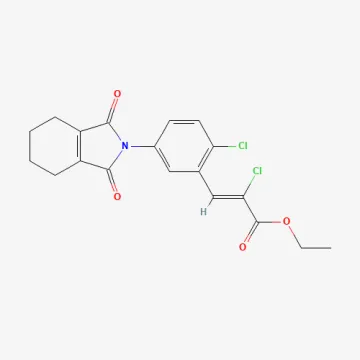
Description
Mode of action
Cinidon-ethyl belongs to the chemical class of cyclohexanedione derivatives, which function as effective contact herbicides. Its primary mechanism involves the inhibition of the protoporphyrinogen oxidase (PPO) enzyme, crucial for chlorophyll synthesis.
By blocking this specific enzyme, the compound induces the accumulation of metabolic intermediates in the weed tissues, causing oxidative stress. This leads to the rapid destruction of cell membranes and the eventual death of the plant.
The substance acts primarily through contact with the leaf surface, requiring thorough coverage to achieve the desired effect. Its systemic movement within the plant is relatively limited compared to other classes of herbicides.
Visual symptoms of damage, such as leaf yellowing and necrosis, appear shortly after application. This rapid reaction is a characteristic of PPO inhibitors, especially under conditions of adequate light.
The selectivity of cinidon-ethyl is based on the differential rate of metabolism between weeds and target crops. This allows for safe usage in cereal cultivation while providing superior control of competing weed species.
What it targets
Cinidon-ethyl is primarily used to control a wide range of annual broad-leaved weeds in cereal crops. It effectively manages species that have become resistant to other herbicide groups, such as sulfonylureas.
Common targets include weeds like white goosefoot, pigweed species, smartweeds, and common ragweed. These plants are susceptible to cinidon-ethyl, especially when treated at early developmental stages.
Controlling these weeds early in the season is vital for preventing yield losses caused by competition for light, water, and nutrients. Efficient management of these weeds helps optimize the growth of cereal crops.
The herbicide is particularly valued in integrated pest management programs for its ability to rotate with other chemical modes of action, thereby helping to mitigate the development of weed resistance.
Success depends on applying the product when weeds are small and vigorously growing, ensuring that the active ingredient can be absorbed and cause lethal damage quickly.
Rates and timing
Application rates for cinidon-ethyl are determined by the weed composition and the density of the infestation. Using the minimum effective dose ensures optimal weed suppression without unnecessary chemical loading.
The best results are achieved when applications are timed to the early growth stages of weeds, typically between the cotyledon and four-leaf stage. Delaying application significantly reduces the herbicidal efficacy.
It is often recommended to use the product in tank mixes to broaden the spectrum of controlled weed species, particularly when multi-species infestations are present in the fields.
Environmental conditions play a critical role; moderate temperatures and appropriate humidity levels favor the activity of the herbicide. Extreme heat or drought can lead to suboptimal performance.
Proper calibration of spraying equipment is essential to ensure a fine, uniform mist that covers the target weeds evenly, as the contact nature of the herbicide demands high-quality application.
Restrictions
Strict adherence to application guidelines is necessary to avoid phytotoxicity. Even with selectivity, excessive dosage can temporarily stress the crop, impacting its overall performance and development.
Avoid applying the herbicide if frost is predicted or if there has been recent heavy precipitation that may have compromised the leaf cuticle, as this increases the risk of absorption by the crop.
Personal Protective Equipment (PPE) is mandatory for all personnel involved in the handling and application of this chemical. Exposure can cause irritation, and safety protocols must be followed rigorously.
Prevent spray drift onto adjacent fields or non-target crops, especially those sensitive to herbicides, such as legumes or sugar beets. Check weather conditions, particularly wind speed and direction, before starting.
Storage must be in a secure, climate-controlled facility inaccessible to unauthorized persons. Ensure that no runoff or spillages reach water sources, as the product is toxic to aquatic life.
Regulatory
Status in the European Union
Not approved in the EU
- CAS number
- 142891-20-1
- Category (EU)
- HB - Herbicide
- ADI
- 0.01 mg/kg bw/day
- ARfD
- Not appl.
- AOEL
- 0.02 mg/kg bw/day
Hazard classification (CLP)
Aquatic Acute 1 - H400Aquatic Chronic 1 - H410Carc. 2 - H351Skin Sens. 1 - H317
EU legislation
EU status is for reference only and does not replace national registration in your country.
Content graph
Connections · Cinidon-ethyl
Most often together:
Marketplace