
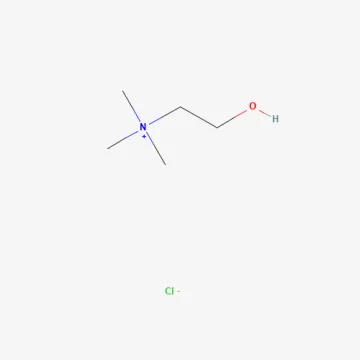
Choline chloride
Description
Mode of action
Choline chloride is recognized in agricultural science as a vital plant growth regulator and a physiological biostimulant. It plays a fundamental role in plant metabolism, influencing cell membrane permeability and the activation of essential enzyme systems during various developmental stages.
The primary function of this compound involves optimizing the plant's internal metabolic processes, which allows crops to utilize resources more efficiently. By supporting the biochemical stability of plant tissues, choline chloride helps plants better withstand environmental stresses, particularly temperature fluctuations.
The mechanism of action is linked to the regulation of protein and nucleic acid biosynthesis, which accelerates cell division and elongation. By improving the physiological status of the plant, it promotes healthier development and enhances the efficiency of structural growth.
Unlike synthetic pesticides intended for pest control, choline chloride acts as a biological modulator. It works by adjusting the plant's internal rhythms, effectively helping the crop realize its genetic potential under suboptimal growing conditions.
Furthermore, the application of choline chloride has been shown to improve root system development. A stronger root architecture leads to better nutrient and water uptake from the soil, creating a foundation for resilient plant growth and increased final biomass production.
What it targets
Choline chloride is utilized across a diverse range of agricultural crops, including cereals, legumes, vegetables, and fruit-bearing trees. Its main purpose is to maintain plant vitality during critical periods of physiological stress or rapid development.
It is effective in mitigating the negative impacts of abiotic stress, such as drought or cold spells. Additionally, it is frequently used to recover crops from herbicide-induced phytotoxicity, allowing the plant to resume normal growth patterns more quickly.
In cereal production, the application is particularly beneficial during the tillering or stem elongation phases. This support helps in establishing an optimal number of productive stems, which is a crucial factor in achieving target yield levels.
For fruit and vegetable crops, the substance is used to reduce flower and fruit drop, improving fruit set and development. This leads to higher yields and better produce quality, including improved storage characteristics and nutritional value.
The biostimulant properties are also highly valued in seedling production. It helps young plants recover from the shock of transplantation, ensuring a uniform and healthy stand establishment in both open field and greenhouse environments.
Rates and timing
The dosage of choline chloride is strictly dependent on the crop type, growth stage, and specific agronomic objectives. Precision in calculating application rates is essential to ensure that the stimulatory effect is achieved without inducing excessive vegetative growth.
For cereal crops, application is most effective during the early stages of growth, such as the onset of tillering. Precise timing ensures that the physiological benefits are aligned with the formation of the plant's reproductive organs.
When treating vegetable crops, applications are generally scheduled during periods of rapid leaf expansion or early flowering. Ensuring even coverage of the foliage is critical, as the substance is primarily absorbed through the leaves before being translocated within the plant.
Optimal conditions for application include early morning or late afternoon hours to minimize evaporation and maximize absorption. Strong winds should be avoided to ensure uniform distribution and prevent off-target drift.
Typically, a limited number of applications per season is recommended to maintain the natural balance of plant hormones. Adhering to the manufacturer's suggested intervals between treatments is vital to avoid over-stimulation or hormonal disruption.
Restrictions
While choline chloride is generally considered to have a favorable safety profile, it must be handled according to standard agricultural practices. Protective equipment, including gloves and masks, is recommended when handling concentrated formulations to prevent skin or respiratory irritation.
Mixing guidelines must be followed strictly, as choline chloride may not be compatible with highly alkaline solutions. Such mixtures can cause chemical degradation of the active ingredient, rendering the treatment ineffective.
Storage requires cool, dry conditions away from direct sunlight, which can cause slow degradation of the compound. Containers should be kept tightly sealed and stored in a secure location to maintain product integrity over time.
Environmental care is paramount; application should be planned to prevent any runoff into nearby water bodies. Although it is not a traditional toxic pesticide, maintaining high standards of chemical management is essential for preserving the local ecosystem.
Always conduct a compatibility test before mixing with other fertilizers or pesticides in a spray tank. Given the complexity of modern crop protection programs, verifying that all components work together without antagonistic effects is a key best practice for farmers.
Status in the European Union
Not approved in the EU
- CAS number
- 67-48-1
- Category (EU)
- RO - Rodenticide
EU status is for reference only and does not replace national registration in your country.