

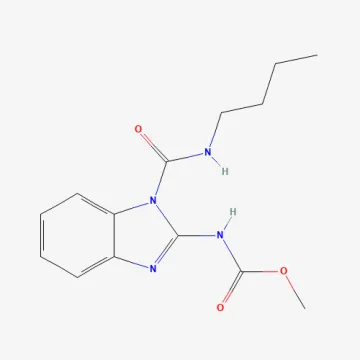
Description
Mode of action
Benomyl belongs to the benzimidazole chemical class and is a systemic fungicide with a broad spectrum of activity. Upon application, the substance quickly penetrates plant tissues and begins to block the pathogen's cell division processes.
The primary mechanism of action involves the inhibition of beta-tubulin synthesis, which disrupts the formation of spindle microtubules. Without this process, the fungal cell loses its ability to multiply.
The product possesses both protective and curative properties, effectively halting infection development at early stages. Within plants, benomyl is partially converted into carbendazim, which also exhibits high fungicidal activity.
Due to its systemic properties, the substance is distributed acropetally, protecting not only treated parts but also new growth. This ensures a long-lasting protective effect of the product.
The active ingredient is characterized by high efficacy even at low temperatures, making it suitable for use at the beginning of the growing season.
What it targets
Benomyl is used to control a wide range of fungal diseases affecting cereals, vegetables, fruits, and ornamental crops. It is effective against various species of powdery mildew.
The product actively suppresses pathogens causing cercosporosis, anthracnose, fusarium wilt, grey mold, as well as various leaf and stem spot diseases.
- Powdery mildew fungi
- Root and crown rots
- Leaf spots and anthracnoses
- Seed mold
- Grey mold of berries and fruits
It is often used as a seed treatment before planting to prevent soil-borne infections and protect seedlings at an early stage.
Benomyl also finds application in post-harvest treatment of fruits to prevent decay during long-term storage, which significantly reduces crop losses.
Rates and timing
Application rates for benomyl depend on the crop type and the treatment method, ranging from 0.5 to 1.5 kg of active ingredient per hectare. Precise dosages must strictly comply with the specific product regulations.
For seed treatment, encrustation or humidification methods are usually employed, ensuring an even distribution of the fungicide over the grain surface.
When spraying vegetative plants, it is important to achieve uniform coverage of leaf surfaces while avoiding runoff of the working solution into the soil.
The timing of treatments is determined by the phytosanitary status of the crops, but it is preferable to apply them preventively or at the first signs of disease.
The number of treatments per season is restricted to prevent the accumulation of residues and the development of pathogen resistance.
Restrictions
The main limitation of using benomyl is the risk of resistance development within fungal populations. Constant use of products from the same benzimidazole group is unacceptable.
To prevent the development of resistance, it is necessary to rotate benomyl with fungicides of other chemical classes that have a different mechanism of action.
The product is toxic to bees and aquatic organisms, so it is strictly forbidden to perform treatments during periods of active bee flight and near bodies of water.
When working with the fungicide, it is mandatory for personnel to use personal protective equipment for the skin, respiratory tract, and eyes.
It is necessary to observe established pre-harvest intervals to ensure the safety of the final product for the consumer.
Content graph
Connections · Benomyl
Most often together:
Marketplace
Products · 12


Fundazim
ТОВ «Фабрика агрохімікатів», Черкаси, Україна
Fungicides
0
0
·
1.8K
23 offers
14.97 €per 1 l
Buy

Lametil WP
Nanjing No.1 Pesticide Factory of Red Sun Group Co., Ltd.
Fungicides
0
0
·
1.4K
2 offers
1.78 €per 1 l
Buy


Fundazim z.p.
«Нанджин Ессенс Файн-Кемікал Ко. Лтд» (Китай)
Fungicides
0
0
·
38
2 offers
256.68 €per 1 l
Buy

Benorad z.p.
ЗАТ Фірма Август, Росія.,селище Вурнари,
Fungicides
0
0
·
36
3 offers
11.52 €per 1 l
Buy


Lamethyl WP z.p.
Nanjing No.1 Pesticide Factory of Red Sun Group Co., Ltd.
Fungicides
0
0
·
37
No offers
—
Details