

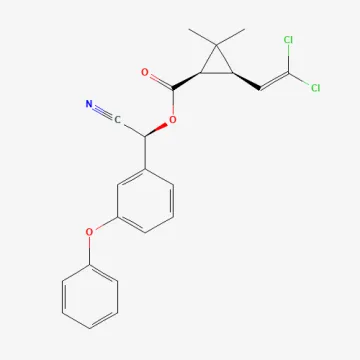
Active ingredient
Especially harmful
Alpha-cypermethrin
Description
Mode of action
Alpha-cypermethrin belongs to the synthetic pyrethroid chemical class. It is a highly active isomer of cypermethrin, providing enhanced biological efficacy against a wide range of agricultural pests.
The mode of action involves disrupting the permeability of insect cell membranes. By affecting sodium channels in the nerve cells, the substance causes persistent nerve excitation.
This rapid depolarization leads to immediate paralysis and subsequent death of the pest. This phenomenon is commonly referred to as the knock-down effect in crop protection.
The substance acts primarily through contact and ingestion. Since it is not a systemic insecticide, thorough coverage of the plant surface is essential for maximum efficacy.
The high initial toxicity of this active ingredient allows for rapid control of pest outbreaks in various agricultural settings immediately following application.
What it targets
Alpha-cypermethrin is a powerful, broad-spectrum insecticide. It is effective against various orders of insects, including Coleoptera, Lepidoptera, Hemiptera, and Diptera.
It is commonly used on cereal crops to control pests such as grain beetles, cereal leaf beetles, and wheat bugs that significantly impact yield quality and quantity.
In sugar beet and vegetable crops, the substance controls populations of weevils, moths, aphids, and various leaf-feeding caterpillars throughout the growing season.
Technical crops like rapeseed and sunflowers benefit from its use in controlling specific pests such as pollen beetles and stem-boring insects during critical development stages.
A notable advantage is its stability and efficacy at lower temperatures, making it a reliable choice for early-season pest management programs.
Rates and timing
Application rates typically range from 0.1 to 0.3 liters per hectare, depending on the pest pressure, crop stage, and specific environmental conditions during the application.
The timing of the application should be determined based on regular field scouting and economic threshold assessments to ensure the most efficient use of resources.
Achieving uniform distribution of the spray solution across the canopy is vital. High-quality spray equipment is recommended to ensure the product reaches the target pests.
When mixing, it is essential to follow manufacturer guidelines regarding water volume and concentration to avoid potential crop phytotoxicity or reduced performance.
Rotation strategies should be employed to manage the interval between sprays, ensuring that the pest population does not develop resistance to pyrethroid chemicals.
Restrictions
Alpha-cypermethrin is highly toxic to honeybees and other beneficial pollinators. Spraying during crop flowering periods when bees are active must be strictly avoided.
Do not apply during periods of extreme heat or high wind speeds. Optimal application conditions are generally at temperatures between 10 and 22 degrees Celsius.
To prevent the development of insecticide resistance, farmers should rotate this active ingredient with insecticides from different chemical classes and modes of action.
Operators must wear appropriate personal protective equipment (PPE) during handling and application to minimize risks associated with exposure to this pesticide.
The substance is toxic to aquatic organisms. Strict buffer zones must be maintained near water bodies to prevent contamination and protect local aquatic life.
Regulatory
Status in the European Union
Not approved in the EU
- CAS number
- 67375-30-8
- Approved from
- 01.11.2019
- Approval until
- 07.06.2021
- ADI
- 0.00125 mg/kg bw/day
- ARfD
- 0.00125 mg/kg bw
- AOEL
- 0.0005 mg/kg bw/day
Hazard classification (CLP)
Acute Tox. 3 - H301Aquatic Acute 1 - H400Aquatic Chronic 1 - H410STOT RE 2 - H373STOT SE 3 - H335
EU legislation
EU status is for reference only and does not replace national registration in your country.
Content graph
Connections · Alpha-cypermethrin
Most often together:
Marketplace


