

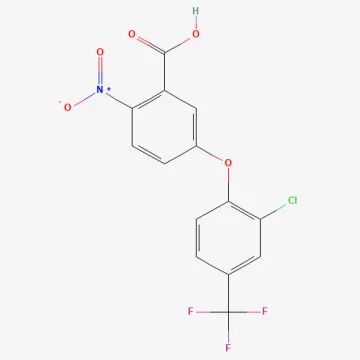
Description
Mode of action
Acifluorfen is a selective contact herbicide belonging to the diphenyl ether chemical class, primarily used for weed control in leguminous crops.
The herbicide works by inhibiting the enzyme protoporphyrinogen oxidase (PPO), which is a critical component in the chlorophyll biosynthesis pathway in plants.
The inhibition leads to the accumulation of toxic intermediates, which, upon exposure to sunlight, cause rapid lipid peroxidation and destruction of plant cell membranes.
Because it is a contact herbicide, it has limited systemic mobility within the plant, meaning it primarily affects the foliage that comes into direct contact with the spray.
Soybeans demonstrate inherent tolerance to acifluorfen due to their ability to rapidly metabolize the active ingredient into non-toxic compounds, allowing for safe usage during crop development.
What it targets
Acifluorfen is highly effective against a broad range of annual broadleaf weeds commonly found in soybean production systems.
Primary target weeds include species such as ragweed, pigweed, smartweed, velvetleaf, and common cocklebur, which can significantly compete with crops for resources.
The herbicide provides the best control when applied to small, actively growing weeds at the cotyledon to two-leaf growth stage.
As weeds grow larger, their susceptibility to acifluorfen decreases significantly, often requiring higher doses or combination treatments with other herbicides.
The product does not provide effective control against grass weeds, necessitating the use of alternative herbicides if grass infestation is present.
Rates and timing
Application rates for acifluorfen depend on the weed species spectrum, weed size, and the specific growth stage of the soybean crop at the time of application.
The ideal application window for soybeans is between the first and third trifoliate leaf stages to minimize crop injury and maximize weed control efficacy.
Environmental conditions such as temperature and humidity play a significant role in performance; warm and sunny conditions generally enhance the speed of herbicidal action.
The use of adjuvants or surfactants is often recommended to improve the wetting and penetration of the herbicide through the leaf cuticle of the target weeds.
Precise sprayer calibration is essential to ensure uniform coverage while minimizing drift onto neighboring non-target areas or sensitive crops.
Restrictions
Transient leaf bronzing or spotting on soybean plants is a typical reaction to acifluorfen application and usually does not result in yield loss.
Do not apply this herbicide if the crop is under stress from drought, waterlogging, or extreme temperatures, as this may increase the risk of phytotoxicity.
Avoid tank-mixing with other pesticides or fertilizers without confirming compatibility, as some combinations can enhance crop injury or reduce herbicidal efficacy.
Operators must adhere to strict safety protocols, using personal protective equipment when handling, mixing, or applying the chemical to prevent exposure.
Equipment cleaning protocols must be strictly followed after use to prevent contamination issues when the sprayer is next used on sensitive crop varieties.
Regulatory
Status in the European Union
Not approved in the EU
- CAS number
- 50594-66-6
Hazard classification (CLP)
Acute Tox. 4 - H302Aquatic Acute 1 - H400Aquatic Chronic 1 - H410Eye Dam. 1 - H318Skin Irrit. 2 - H315
EU legislation
EU status is for reference only and does not replace national registration in your country.
Content graph
Connections · Acifluorfen
Most often together:
Marketplace
Products · 8


Flagman Extra
ТОВ «Фабрика агрохімікатів», Черкаси, Україна
Herbicides
0
0
·
46
2 offers
11.28 €per 1 l
Buy


Volens, ME (acifluorfen, 200 g/l + cloquazim, 42 g/l)
Peters & Burg Kft.
Herbicides
0
0
·
27
3 offers
14.94 €per 1 l
Buy