
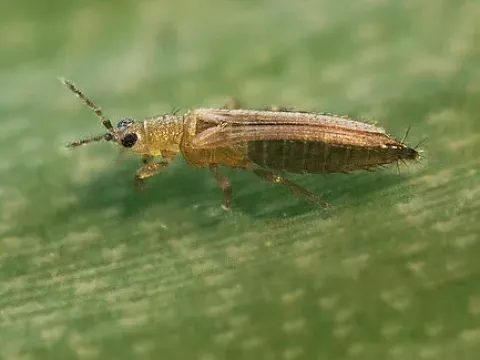
Bristly thrips
Thrips setosus
The bristly thrips (Thrips setosus) is a small insect belonging to the order Thysanoptera and the family Thripidae, recognized as a significant pest in agricultural settings.
What the section contains
Bristly thrips
Adults are typically dark-colored, reaching about 1-1.5 mm in length, and possess distinct bristles on their bodies, which are observable under magnification.
The life cycle encompasses egg, larva, propupa, pupa, and adult stages, with significant portions of the development cycle often occurring within the soil.
These insects are highly adaptable, capable of rapid population growth, especially in controlled environments like greenhouses where generations overlap continuously.
Due to their small size and mobility, they can easily disperse via air currents, making containment challenging for large-scale production farms.
Bristly thrips primarily infest vegetable crops, with solanaceous plants such as tomatoes, peppers, and eggplants being particularly susceptible to severe damage.
By feeding on plant sap, they damage epidermal tissues, causing cell collapse and significantly hindering the plant's ability to photosynthesize and grow efficiently.
Beyond direct feeding damage, they are notorious vectors for various plant viruses, most notably the Tomato Spotted Wilt Virus (TSWV), which causes systemic necrosis.
Infested crops often exhibit stunted growth, flower abortion, and deformed fruit, leading to significant yield losses and reduced quality of harvested produce.
The presence of thrips can render an entire harvest unmarketable due to the aesthetic damage and the risk of pathogen transmission to healthy plants.
In temperate climates, adult thrips emerge in late spring or early summer as temperatures rise, moving from wild hosts to cultivated crops.
Greenhouse environments provide ideal year-round conditions for development, allowing the pest to flourish regardless of the external seasonal changes.
Populations tend to peak during hot and dry weather conditions, which accelerate their metabolic rate and significantly reduce the time between successive generations.
Migration typically occurs from nearby weedy areas or previously harvested crops, making surrounding vegetation management a crucial aspect of early-season protection.
As winter approaches, individuals may move to sheltered locations or the soil surface to enter a state of dormancy, surviving until the next growth season.
Early symptoms of infestation include the appearance of tiny silver or white streaks on leaves, which occur as cells are drained of their contents and air fills the cavities.
The presence of dark, irregular fecal spots on the underside of foliage serves as a reliable indicator of active thrips colonies on the plant.
Leaf curling and shoot deformation are common signs of severe infestation, often accompanied by necrotic patches that expand as the damage progresses.
On fruit, feeding damage manifests as speckled or scarred surfaces, often referred to as "silvering," which greatly diminishes the market value of the crop.
Yellow or blue sticky traps placed near crops are highly effective for detecting the presence of adults before their population reaches damaging levels.
Integrated Pest Management (IPM) is essential for controlling bristly thrips, beginning with strict sanitation to remove weeds and debris that host the pest.
Biological control agents, including predatory mites (such as Amblyseius species) and pirate bugs (Orius), are effective tools for suppressing populations in greenhouses.
Chemical intervention may be required during outbreaks, utilizing systemic insecticides; however, rotation of different active ingredients is crucial to avoid resistance.
Physical barriers, such as fine-mesh insect screening on greenhouse vents, provide an effective defense against the immigration of adult thrips from outside.
- Regular monitoring with colored sticky cards to detect population spikes.
- Destruction of crop residues immediately after harvest to disrupt the life cycle.
- Proper irrigation and humidity management to create less favorable conditions for the pest.
- Avoid over-fertilization, as succulent tissue is more attractive to sap-feeding insects.