
Brazilian thrips
Caliothrips brasiliensis
Description
How to identify
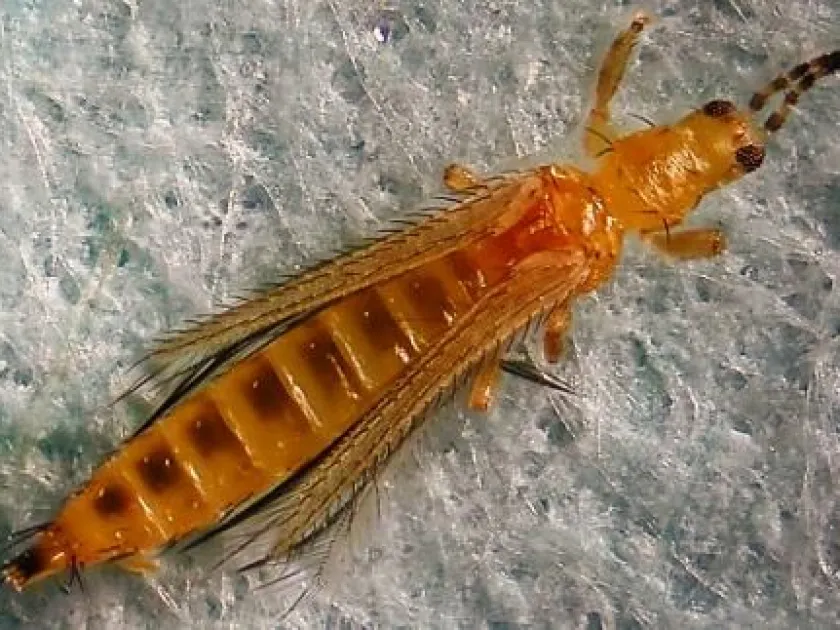
The Brazilian thrips (Caliothrips brasiliensis) is a small insect belonging to the order Thysanoptera and the family Thripidae. Adult specimens are recognizable by their dark, almost black color and a distinct reticulate pattern on the head and pronotum.
Their wings are narrow and fringed, often displaying characteristic dark transverse bands. The life cycle consists of several stages: egg, two larval instars, propupa, pupa, and adult.
Larvae are generally light-colored, ranging from pale yellow to white, and lack functional wings, making them move relatively slowly compared to the active adults.
This species is known for its ability to reproduce parthenogenetically, which contributes to its rapid population growth during favorable agricultural seasons.
Proper identification requires professional microscopic examination, although their presence in fields can be confirmed using sticky traps and leaf inspections.
What it damages
The primary hosts for Caliothrips brasiliensis include various legume crops like soybeans, peanuts, and beans, as well as some solanaceous plants.
These insects damage crops by piercing the plant cells and feeding on the sap, which disrupts the photosynthetic process and physiological function of the leaves.
As feeding progresses, the plant cells collapse, leading to chlorosis, stunted growth, and in severe cases, the drying out and shedding of leaves.
Besides direct mechanical damage, they are recognized as potential vectors for plant viruses, further complicating the management of infected fields.
High population densities can cause significant yield losses, affecting both the quality and quantity of the harvest, particularly during seed-filling stages.
When it appears
The prevalence of the Brazilian thrips is heavily influenced by temperature and humidity, with peak activity occurring during hot and dry summer months.
Adult thrips emerge from their overwintering sites in the soil or crop debris as temperatures rise, typically moving onto developing crops during late spring.
In warm climates, the generation cycle is very short, allowing the population to increase exponentially throughout the growing season.
As the weather cools in late autumn, the insects descend into the soil profile to pass through the winter in a state of diapause.
Frequent scouting during the flowering and pod formation stages is essential to monitor for surges in their population density.
Signs of infestation
Initial signs of infestation are manifested as small, whitish or silvery spots appearing on the leaves due to the destruction of epidermal tissues.
The underside of infested leaves will often show dark fecal spots, which are a characteristic sign indicating the presence of thrips colonies.
Severe infestations result in the overall yellowing or "bronzing" of the foliage, giving the canopy a dull and unhealthy appearance from a distance.
Deformation of young shoots and stunted growth are common symptoms observed in high-pressure scenarios, reducing the plant's overall vigor.
Reproductive parts may also be attacked, leading to flower drop and the formation of empty or underdeveloped pods and seeds.
Control measures
Effective management starts with cultural practices, such as removing alternative host weeds and ensuring clean field borders.
Deep plowing after harvest helps destroy overwintering sites, significantly reducing the initial pest population for the following year.
Chemical control is often necessary during outbreaks; systemic insecticides are typically most effective when applied early in the infestation.
- Regular monitoring using sticky cards to determine the need for intervention.
- Use of biological control agents, including predatory mites and bugs.
- Crop rotation to break the cycle of pest colonization in the soil.
Adopting an integrated pest management (IPM) approach is recommended to balance chemical usage and preserve beneficial insect populations in the field.
Taxonomy
- Latin name
- Caliothrips brasiliensis
- Order
- Thrips
- Family
- Thripidae
- EPPO code
- CALHBR
Discussion
No discussions yet — be the first.