
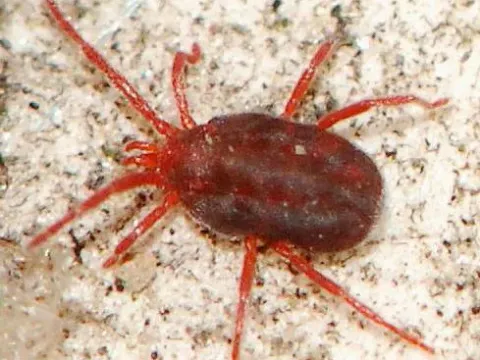
Harvest mite
Trombicula irritans
The harvest mite, scientifically known as Trombicula irritans, belongs to the family Trombiculidae within the order Trombidiformes. Adult mites are soil-dwelling, free-living organisms that feed on tiny arthropods and organic debris.
What the section contains
Harvest mite
The larval stage, commonly referred to as a chigger, is the only parasitic phase of this mite's life cycle. They are microscopic, typically measuring about 0.2–0.3 mm, with a distinctive reddish or orange color.
The life cycle progresses through several stages: egg, larva, protonymph, deutonymph, tritonymph, and adult. Only the larvae are capable of attaching to a vertebrate host.
They are primarily found in moist, shady environments with dense ground vegetation, which provides the necessary humidity for their survival and development.
Despite their name, they are not a agricultural threat to plant life but a significant nuisance for gardeners and outdoor enthusiasts due to their bite.
Trombicula irritans is not a phytophagous pest; it does not consume plant tissues or cause economic damage to agricultural crops, fruit trees, or vegetable gardens.
The harm caused by these mites is strictly related to human and animal health. The larvae attach to the skin of warm-blooded hosts, including pets, livestock, and people.
The bite triggers an intense allergic reaction, characterized by severe itching and red papules on the skin. This can lead to secondary infections if the affected area is scratched excessively.
Their presence on a property can make gardening or outdoor recreational activities highly unpleasant and potentially hazardous for sensitive individuals.
In farming environments, they may affect livestock, causing distress and potential loss of condition in poultry or small animals that roam in infested grassy areas.
The activity of harvest mite larvae is strictly seasonal, depending on the temperature and humidity levels within the top layer of the soil.
The peak activity period occurs during the summer months, typically from June through August, when conditions are warm and humid enough to support larval movement.
They are most active during dry, sunny spells that follow rainy weather, as these conditions encourage them to climb onto the tips of grass blades to wait for a host.
The mites are generally inactive during the cooler months of the year, spending this time in the soil as nymphs or adults deep in the ground.
Temperature fluctuations significantly influence their behavior, with extreme heat causing them to retreat deeper into the cooler, damper soil layers.
The most evident sign of a harvest mite infestation is the sudden appearance of itchy skin welts following exposure to garden vegetation, tall weeds, or wooded areas.
The bites are often concentrated in areas where clothing fits tightly against the skin, such as ankles, waistbands, or armpits, as larvae get trapped in these spots.
You can identify their presence by placing a small white tile or cloth sheet on the ground in grassy areas; within minutes, the microscopic orange larvae will crawl onto it.
Overgrown lawns, dense shrubbery, and accumulation of leaf litter are primary indicators that the environment is suitable for a harvest mite population.
Pets showing signs of discomfort, scratching, or restlessness after being in the yard may indicate that the local vegetation is infested with chiggers.
Managing harvest mites is primarily focused on modifying the garden environment to make it less hospitable for the larvae.
- Regularly mow the lawn and keep vegetation trimmed to minimize moisture and humidity near the ground.
- Clear away piles of decaying leaves and organic garden debris, which serve as breeding and nesting sites for mites.
- Control local rodent populations, as they are primary hosts for the mites in the wild, helping to maintain the population.
- Use appropriate acaricides on the periphery of the property to create a barrier, if infestation levels are extremely high.
- Wear long-sleeved clothing and trousers tucked into socks when working in susceptible areas of the garden to prevent larvae from reaching the skin.