
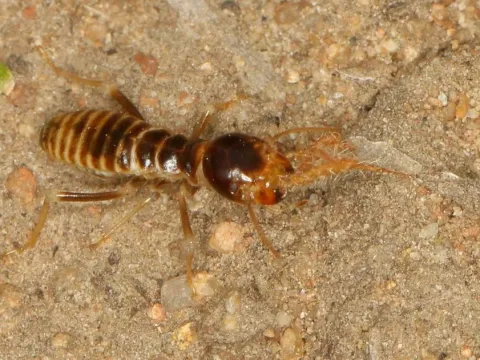
Haviland harvester termite
Hodotermes havilandi
The Haviland harvester termite (Hodotermes havilandi) belongs to the Hodotermitidae family. Unlike wood-boring termites, these insects are known for foraging on the soil surface, harvesting dry and green plant material to store in their deep subterranean nests.
What the section contains
Haviland harvester termite
These termites exhibit a complex social structure with specialized castes. Workers are the most frequently encountered individuals, characterized by their ability to survive in arid environments due to the stable humidity maintained within their deep galleries.
Physically, they possess robust mandibles adapted for cutting through tough plant stems and grass blades. Their coloration allows them to blend in with desert and semi-arid soil environments, providing a degree of camouflage from natural predators.
Their life cycle is closely synchronized with seasonal rainfall patterns, which trigger the nuptial flights. After these flights, alates shed their wings and establish new colonies, which expand over several years to form mature, destructive populations.
The population density is largely influenced by the availability of food sources and soil conditions. In agricultural landscapes, their presence is often intensified by the proximity of monoculture crops that serve as a consistent food supply.
Hodotermes havilandi is a significant threat to various agricultural crops, including wheat, barley, and maize. They primarily target the base of the stems, causing the plants to collapse, which severely impacts overall crop health and yield.
Beyond crop loss, these termites cause extensive damage to rangelands by removing forage grasses. This creates competition with livestock and accelerates soil erosion, as the vegetation cover that holds the topsoil is systematically cleared.
In cases of severe infestation, termites can strip a field of nearly all plant matter, leaving patches of bare soil. This is particularly problematic in dry regions where natural vegetation recovery is slow and prone to degradation.
The feeding pattern is often concentrated around foraging tunnels. When natural vegetation is scarce, the termites become more aggressive, attacking emerging seedlings and preventing the establishment of a healthy crop stand.
This species is notorious for its ability to cut and transport vast quantities of material. Even if they do not consume the entire crop, the damage to the plant's structural integrity often renders it unrecoverable and susceptible to other environmental stressors.
The most visible indicator of activity is the construction of earthen tubes or protective crusts over foraging areas. These structures shield the termites from the sun and dehydration as they harvest plant material on the surface.
Patches of sudden wilting or lodging in cereal crops without apparent signs of disease or moisture stress often indicate subterranean termite activity. Careful inspection of the stem base usually reveals distinct gnaw marks.
Entry holes in the soil, often surrounded by small mounds of debris or earth, mark the access points to their deep nesting systems. These points serve as the hub for worker activity throughout the foraging process.
In heavily infested fields, workers can be spotted during cooler parts of the day, such as early morning or late evening, as they actively move material toward the nest entrances.
Large areas of cleared vegetation where the termites have systematically harvested the plant cover are clear signs of a well-established and long-standing colony in the vicinity.
Mechanical control through deep plowing is a fundamental method to disrupt the subterranean galleries and nests. This physical destruction forces the colony to relocate or suffer from environmental exposure, significantly reducing their numbers.
Targeted use of slow-acting toxic baits has shown promise. Workers consume the bait and return it to the colony, effectively spreading the poison and leading to the eventual collapse of the entire nest structure, including the queen.
Biological control agents, particularly entomopathogenic fungi, are increasingly used in integrated pest management strategies. These fungi naturally infect termites and can reduce population density without leaving harmful chemical residues in the soil.
- Deep mechanical tillage to destroy nest structures.
- Systemic seed treatments to protect young seedlings.
- Use of slow-acting insecticide baits.
- Crop rotation to minimize consistent food sources for colonies.
Monitoring the fields for signs of foraging tubes allows for early intervention. By controlling the population before it reaches peak levels, farmers can protect their crops and prevent long-term damage to the soil and pasture quality.