
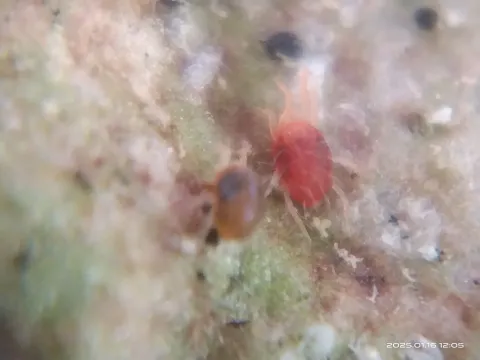
Carnation spider mite
Tetranychus dianthica
The carnation spider mite (Tetranychus dianthica) is a member of the Tetranychidae family, specifically recognized as a pest affecting various species of the Dianthus genus.
What the section contains
Carnation spider mite
These mites are extremely small, typically measuring less than half a millimeter in length, making them difficult to detect without the use of a magnifying glass.
Their body color is variable, often changing from yellowish-green to reddish-brown depending on their nutritional source and environmental conditions.
The life cycle involves an egg stage, a larval stage, and two nymph stages before reaching maturity. Under optimal temperatures, a generation can develop in as little as one week.
Adult females hibernate in protected areas such as soil cracks, debris, or greenhouse structures, emerging when conditions become favorable for egg-laying.
The primary hosts of this mite are carnations and other dianthus species, which are frequently damaged in both field and greenhouse production systems.
Mites use their piercing-sucking mouthparts to feed on plant cell contents, primarily targeting the leaves and stems, which disrupts the photosynthetic process.
By removing cell content, the mites cause localized cell death, which results in the characteristic chlorotic spotting seen on the upper surfaces of the leaves.
The presence of fine webbing, produced by the mites to create a protected micro-environment, can lead to dust accumulation and further reduce plant vitality.
Severe infestations often lead to a reduction in flower quality, stem stunting, and overall plant decline, which significantly impacts the market value of the crop.
Initial infestation is marked by tiny white or yellow stippling on the leaves, which gives the plant a speckled or chlorotic appearance as the damage progresses.
As the mite population grows, leaves begin to turn yellow, dry out, and eventually curl or fall off, leading to premature defoliation of the plant.
A visible presence of delicate, silky webs between the leaves or on the undersides of leaves is a definitive indicator of an established mite colony.
The growth of the plant may slow significantly, and the production of healthy, high-quality buds may be severely limited due to the stress induced by feeding.
Careful observation with a hand lens will reveal the mobile mites crawling near the veins of the leaves, along with numerous spherical, translucent eggs.
Managing the greenhouse environment is a critical preventive step, as maintaining higher humidity levels can suppress spider mite reproduction cycles.
Good sanitation practices, including the removal of weeds and infested plant residues, help eliminate overwintering sites for the pest population.
Chemical control should be implemented using specific acaricides, ensuring that thorough coverage is achieved, especially on the undersides of the leaves.
Rotating different modes of action is essential for resistance management, as spider mites are known to develop tolerance to frequently used chemical agents.
- Regular monitoring and early detection of mite outbreaks.
- Introduction of biological control agents like Phytoseiulus persimilis.
- Avoidance of water stress, as drought-stressed plants are more susceptible to damage.
- Implementation of quarantine procedures for new plant material entering the nursery.