
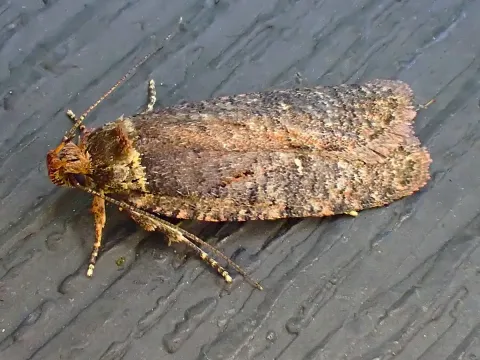
Caraway moth
Depressaria conterminella
The caraway moth (Depressaria conterminella) belongs to the Depressariidae family of moths, within the order Lepidoptera. Adult moths typically have a wingspan of 18–22 mm, with grayish-brown forewings adorned with subtle dark markings.
What the section contains
Caraway moth
The larvae, or caterpillars, reach about 15–18 mm in length. They are typically yellowish-green or brownish with a dark, hardened head capsule. Their bodies feature sparse hairs, which is a characteristic morphological trait of this species in its larval stage.
The pupa of this moth is brown and reaches approximately 10 mm in length. Before pupation, the caterpillar constructs a loose silk cocoon, often hidden within the plant foliage or near the base of the stem to facilitate metamorphosis.
The eggs are minute, oval-shaped, and usually laid singly or in small clusters on the inflorescences or tender leaves of host plants. They transition from white to a reddish hue as they develop and prepare to hatch.
The life cycle is closely synchronized with the growth of host plants in the Apiaceae family. The insect undergoes a complete metamorphosis, including egg, larval, pupal, and adult stages, typically overwintering as an adult moth.
The primary hosts for this pest are plants within the Apiaceae (Umbelliferae) family. Caraway (Carum carvi) is the most economically significant host, suffering the greatest damage from larval feeding.
Other crops, including dill, fennel, and coriander, as well as various wild umbellifers, serve as alternative food sources for the larvae, enabling the pest to maintain population levels throughout the growing season.
Larvae cause direct damage by feeding on buds, leaves, and, most critically, the developing inflorescences. This destruction prevents normal pollination and leads to severe yield losses in seed production.
High infestation rates can lead to the total loss of the flower crop. Because the larvae target the reproductive organs of the plant, the economic impact is immediate and significant for essential oil and spice producers.
Larval feeding also weakens the plant, making it more susceptible to environmental stress and secondary infections. Severely infested plants often wither or fail to produce viable seeds entirely.
Adult moths typically emerge in late summer or early autumn to mate and lay eggs for the following year. They are nocturnal, becoming highly active during dusk and throughout the night.
Overwintering adults emerge in early spring as soon as temperatures remain consistently favorable. This timing aligns perfectly with the initial growth spurt of caraway plants, providing an abundant food source for emerging larvae.
The larval stage coincides with the peak vegetation period of the host crop, typically occurring in late spring and early summer. This is when the caterpillars are most voracious and damaging to the crop.
Pupal development usually takes 10 to 14 days, though this is highly dependent on ambient temperature. In warm, dry summers, the life cycle may shorten, potentially allowing for overlapping generations.
By late July, the lifecycle of the generation typically concludes with the emergence of new adults. In temperate regions, the moth often completes one or two generations per year depending on the climate.
The most prominent sign of infestation is the appearance of silk webbing on the tops of stems. Larvae tie the flower heads and leaves together, creating protective "nests" or silken tubes to feed inside.
Visual inspection often reveals chewed petals, deformed umbels, and the presence of larval frass (excrement) within the silken webbing. These nests are distinct markers of active moth populations in the field.
Plants affected by the moth often show stunted growth, yellowing leaves, or premature drying of flower stalks. In many cases, the main umbel is completely destroyed or hollowed out by the caterpillar.
During evening surveys, adult moths can be observed using light traps, which serves as a reliable indicator for growers to assess the severity of the infestation and plan intervention.
General crop patches that appear thin or uneven, with damaged tops, are clear indicators that the moth has established itself in the field and is actively impacting the harvest potential.
Effective management begins with cultural practices, such as rigorous crop rotation and deep autumn plowing, which buries pupae and debris, thereby disrupting the pest's overwintering sites.
Chemical control should be targeted at early larval instars when the caterpillars are most vulnerable to insecticides. Using systemic or contact insecticides during the budding phase is the standard protective measure.
Biological control methods include the conservation of natural predators, such as ichneumonid wasps, which naturally parasitize the larvae and help regulate moth population levels without chemical intervention.
Integrated Pest Management (IPM) involves regular field monitoring and the use of pheromone traps to identify threshold levels, ensuring that chemical applications are applied only when necessary.
- Utilize selective insecticides during the early budding stage.
- Remove and destroy infested crop residues post-harvest.
- Control wild umbelliferous weeds around the field perimeter.
- Implement crop rotation to avoid continuous host availability.