
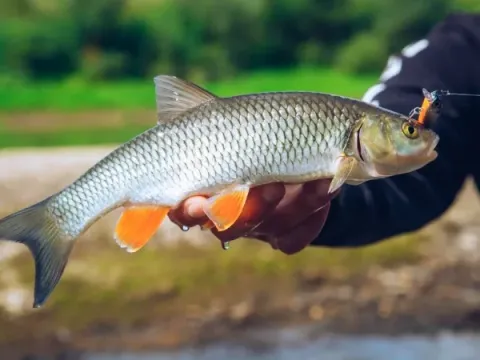
Chub
Squalius cephalus
The European Chub (Squalius cephalus) is a freshwater fish belonging to the Cyprinidae family, commonly found in river systems throughout Europe.
What the section contains
Chub
It is characterized by a sturdy body, large scales, and a broad, powerful head, which allows it to thrive in various water velocities and currents.
As an omnivorous species, it occupies different parts of the river, frequently interacting with human-made structures used for water extraction.
The life cycle involves spring spawning, which occurs in rocky-bottomed areas, potentially coinciding with the start of agricultural irrigation seasons.
Taxonomically, it is classified within the order Cypriniformes, and its widespread presence makes it a factor to consider for riparian agriculture.
The Chub does not damage crops directly but poses a significant challenge to the maintenance of irrigation and water distribution systems.
Large populations congregating near pumping stations can clog water intake screens with biological debris, hindering the supply of water to agricultural fields.
Frequent blockages lead to pressure drops in irrigation lines, potentially resulting in insufficient watering of crops and increased maintenance costs.
The presence of fish near intake points can lead to increased soil erosion at the edges of pumping stations, undermining the stability of the infrastructure.
In addition, biological activity near filters often promotes the growth of algae, which further complicates the mechanical cleaning of the irrigation system.
The activity level of the Chub is highest from early spring through late autumn when water temperatures support high metabolic rates.
During the spring spawning season, the fish are particularly active in shallow water, which is often where irrigation inlets are located.
Summer months keep the Chub mobile as it searches for food, increasing the probability of interference with irrigation equipment and filters.
As autumn progresses, the fish begin to migrate towards deeper wintering grounds, causing a gradual reduction in the pressure on water intake points.
During the winter months, the fish enters a state of low activity, significantly reducing the risk of obstruction for agricultural irrigation facilities.
A primary indicator of presence is the reduced water flow efficiency within the irrigation network and frequent alarms regarding pump pressure.
Finding fish scales, mucus, or shredded aquatic vegetation on the pump intake screens is a clear sign of Chub activity at the intake location.
Visual confirmation of fish schooling near the intake grates suggests that the current is drawing them into potentially harmful proximity to equipment.
Physical damage to the mesh screens, such as warping or tearing, indicates pressure from fish trying to pass through or lodging themselves against the grate.
Inconsistent distribution of irrigation water across fields often points to upstream filtration issues caused by debris or biological interference at the source.
Installing high-durability intake screens with specific aperture sizes is the most effective way to prevent fish entry into irrigation pipes.
Implementing a routine schedule for cleaning and inspecting intake structures is essential to prevent system failures during critical growth stages.
The use of sound-based deterrent systems or acoustic pulses can effectively guide fish away from the sensitive areas of the irrigation intake.
Designing irrigation channels with sedimentation basins can reduce flow velocity and help trap debris before it reaches the main filtration units.
Utilizing modern, self-cleaning filter technology significantly reduces manual maintenance needs and ensures a constant water supply to the crops.