
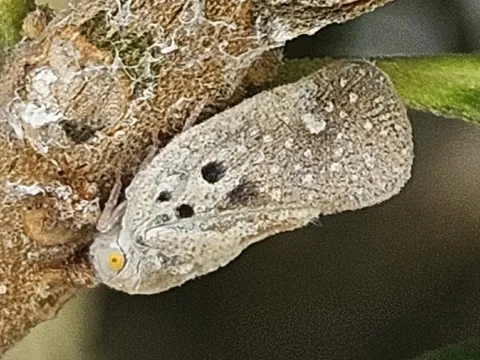
Citrus flatid planthopper
Ormenis pruinosa
The citrus flatid planthopper (Metcalfa pruinosa) is a polyphagous insect belonging to the family Flatidae. Adult insects are approximately 5–7 mm long with a distinct triangular wing shape and a mealy, whitish-gray appearance due to a wax coating.
What the section contains
Citrus flatid planthopper
Nymphs are easily recognizable by their bright white, fluffy appearance. They are often covered in waxy filaments, which frequently leads gardeners to mistake them for mealybugs or fungal mold.
These nymphs are highly mobile and tend to cluster on the undersides of leaves and along tender stems, where they are protected from direct sunlight and predators.
Adults possess strong hind legs, allowing them to jump rapidly when disturbed. This evasive behavior makes manual inspection difficult during the late summer months.
Eggs are oval-shaped and are inserted individually or in small groups under the bark of young twigs, effectively overwintering until the following spring.
As a sap-sucking pest, the citrus flatid planthopper affects a vast range of hosts, including grapevines, citrus trees, numerous fruit species, and various ornamental shrubs.
By piercing plant tissues and consuming phloem sap, the nymphs and adults cause significant physiological stress, stunting growth and reducing the overall vigor of the host plant.
A major indirect symptom of their presence is the secretion of honeydew. This sticky substance serves as an ideal substrate for the growth of sooty mold, which covers leaves in a black, powdery layer.
Heavy infestations can lead to leaf yellowing, curling, and premature senescence. In crops like grapes, this results in significant yield losses and lower fruit quality.
On ornamental plants, the combination of white waxy filaments and black sooty mold severely reduces the aesthetic value, necessitating urgent intervention.
The citrus flatid planthopper completes one generation per year. Overwintering occurs in the egg stage, safely tucked away beneath the bark of host plants.
Egg hatching generally occurs in late spring or early summer, synchronized with the warming of temperatures and the availability of tender new plant growth.
The nymphal stage lasts throughout the summer, during which the insects pass through five distinct instars, feeding continuously and expanding their presence.
Adults emerge from July through August. This period marks the peak of the pest's activity, characterized by mating and widespread dispersal across the garden or orchard.
In the autumn, females deposit their eggs under the bark of woody twigs. These eggs remain dormant through the winter, completing the annual cycle.
The most prominent sign is the appearance of white, cotton-like masses on the undersides of leaves and in the axils of branches, which are the wax secretions of the nymphs.
The presence of sooty mold, which appears as a black, dusty coating on leaves and stems, is a reliable indicator that sap-sucking pests are active nearby.
Quick, jumping insects that scatter when branches are tapped or moved serve as an immediate confirmation of an adult planthopper infestation.
Wilting, distorted foliage or a general lack of growth vigor in affected parts of the plant often correlates with high feeding pressure from planthopper nymphs.
Increased ant activity on branches is a common observation, as ants are attracted to the honeydew secreted by the hoppers and will actively protect them from natural enemies.
Controlling the citrus flatid planthopper is challenging due to the protective waxy covering on both nymphs and adults, which acts as a shield against many contact insecticides.
Effective management requires the application of systemic insecticides, especially during the early nymphal stages before the waxy defense layer becomes fully developed.
Cultural control involves pruning and disposing of heavily infested branches, which helps reduce the overwintering population of eggs and the current number of nymphs.
- Use of systemic insecticides for targeted pest suppression.
- Application of entomopathogenic fungi as a biological control method.
- Physical removal and destruction of infested plant parts.
- Monitoring of ant populations to limit the protection provided to hoppers.
- Quarantine checks on new nursery stock to prevent introduction.
Optimal treatment timing is during the early morning or late evening when the insects are less active and the coverage of systemic sprays is more uniform across the foliage.