
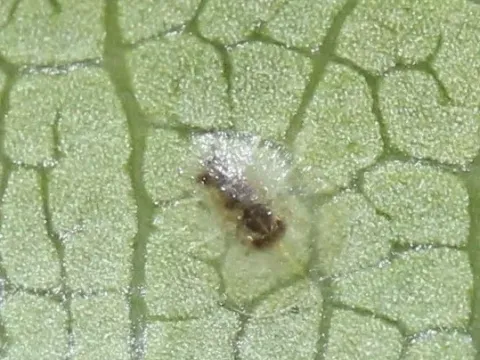
Mango shield scale
Protopulvinaria mangiferae
The mango shield scale (Protopulvinaria mangiferae) is a small sap-sucking insect belonging to the Coccidae family. The adult females have a flat, oval-shaped body covered by a brownish, slightly convex sclerotized cuticle that mimics the plant's surface.
What the section contains
Mango shield scale
Unlike armored scales, this species does not possess a separate wax cover that can be removed; the shell is an integral part of its body structure, making them resilient to contact pesticides.
The juvenile stage, known as "crawlers," are microscopic and highly active. This stage is critical for the insect's dispersal, as they move along the host plant to find suitable feeding sites.
Reproduction is primarily parthenogenetic, with males being extremely rare. This allows a single individual to establish a significant infestation on a healthy host plant.
Their morphological mimicry often makes them difficult to spot in the early stages, as they align themselves with leaf veins or bark crevices to remain inconspicuous to predators and gardeners.
This pest is a polyphagous insect that attacks various crops, including mango, avocado, citrus, ficus, and various ornamental greenhouse plants. They feed primarily on the phloem sap of the host.
Heavy infestations lead to stunted plant growth, leaf chlorosis, and premature leaf drop. The removal of plant nutrients by thousands of individual scales severely weakens the host plant's physiology.
A major indirect symptom is the secretion of honeydew, a sugary byproduct that coats the leaves and serves as a substrate for sooty mold fungus, which inhibits photosynthesis.
In addition to cosmetic damage, the infestation can lead to the deformation of young shoots and tender foliage, which significantly reduces the economic value of commercial fruit crops.
Prolonged stress caused by scale insects makes the plants more susceptible to secondary pathogens, including bacterial infections and opportunistic fungal diseases.
The life cycle of the mango shield scale is strongly influenced by ambient temperature and humidity levels, with warm environments accelerating their reproductive rate.
In greenhouses, this pest can reproduce continuously throughout the year, with overlapping generations, which makes the timing of control measures very challenging.
The peak activity of crawlers usually aligns with periods of active vegetative growth of the host plants, providing them with abundant nutritional resources.
Environmental fluctuations, such as high humidity and temperatures between 25°C and 30°C, can significantly reduce the duration of the life cycle from egg to adult.
In temperate climates, the scale survives the winter months primarily on indoor plants, which act as reservoirs for re-infestation once the warmer season begins.
The first indicator of infestation is usually the presence of sticky honeydew on the leaves, followed by the appearance of black, powdery sooty mold growing on the sticky patches.
Small, brown, oval-shaped bumps located primarily on the underside of leaves or along the midribs are typical signs of adult female scales being present on the plant.
If the plant shows yellowing leaves, tip dieback, or a general lack of vigor despite regular watering, it is highly likely that a scale colony is feeding on its sap.
Small, white, cottony or waxy masses found on stems or leaf undersides indicate egg-laying activity, which signals that the population is preparing to expand.
A failure to bloom or fruit as expected is a common physiological sign of severe infestation, as the plant redirects its limited energy away from reproduction to survive.
Manual removal of scales using a soft brush dipped in a solution of mild soap and alcohol is effective for light infestations on indoor or potted plants.
Systemic insecticides are often required for large-scale infestations, as they move through the plant's vascular system to kill the insects from the inside out.
Horticultural oils or neem-based products help by suffocating the insects; they create a thin barrier that prevents the scale from breathing effectively.
Biological control, including the introduction of natural predators such as lady beetles or parasitic wasps, is a sustainable way to manage populations in tropical environments.
- Inspect all new plants thoroughly before introducing them to your collection.
- Prune and destroy heavily infested branches to reduce the overall population.
- Ensure proper airflow around the plants to decrease the likelihood of sooty mold outbreaks.