
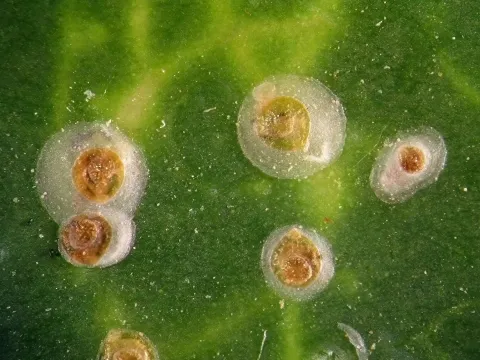
Ixora scale
Protopulvinaria ixorae
The ixora scale (Protopulvinaria ixorae) is a pest belonging to the Coccidae family. These insects are known for their sessile lifestyle as adults, where they remain stationary on the host plant for the majority of their lives protected by a waxy test.
What the section contains
Ixora scale
Adult females are generally flat or slightly convex, possessing a hardened dorsal shield. Their coloration typically blends in with the host plant's stems or the undersides of leaves, making them difficult to detect in the early stages of an infestation.
Males of the species are rarely seen, as they are winged and short-lived, serving only to fertilize the females. The female's ability to reproduce and form white, cottony egg sacs (oviposition sites) is the primary method of population growth within a colony.
These insects prefer to settle along the midribs and veins of leaves, which provides them with easy access to vascular tissues. Identifying the white ovisacs is often the first indicator that a scale population is established on the plant.
The life cycle is largely dependent on environmental factors. In climate-controlled greenhouses or indoor settings, this pest can complete multiple generations in a single year, leading to overlapping populations that are challenging to eradicate.
The ixora scale primarily targets ornamental plants, with Ixora and Gardenia being among their favorite hosts. They drain the vital sap, causing physical and metabolic distress to the host plant throughout the growing season.
Nutrient depletion leads to the development of chlorotic spots on the foliage, where the insect has fed. As these spots grow in number, the plant's photosynthetic capacity decreases, resulting in stunted growth and weakened structural integrity.
A significant secondary issue is the production of honeydew, a sticky sugary secretion. This substance frequently promotes the growth of sooty mold, which creates a dark, unsightly layer on the leaf surfaces, further impeding the plant's ability to thrive.
Heavy infestations can lead to premature leaf drop and the eventual dieback of terminal shoots. If left unmanaged, the cumulative damage can significantly reduce the ornamental value of the plant and increase its vulnerability to other pathogens.
Weakened plants are less capable of resisting environmental stress, leading to a downward spiral in health. Monitoring and early detection are crucial to prevent the spread of these insects to healthy neighboring plants.
The most effective strategy for managing ixora scale begins with the mechanical removal of visible scales using a soft brush or cotton swab soaked in isopropyl alcohol. This should be combined with the pruning of heavily infested foliage.
Systemic insecticides are generally the preferred chemical control method. By applying these to the soil or spraying them onto foliage, the plant absorbs the active ingredients, which then kill the scale insects as they feed on the sap.
Because the protective shell of the scale insect acts as a barrier, contact insecticides have limited success. Therefore, repeated applications over several weeks are essential to control emerging nymphs that were previously protected by the mother's shell.
In greenhouse environments, biological control agents such as predatory beetles or parasitic wasps can be introduced to keep scale populations below economic thresholds without the use of broad-spectrum chemicals.
- Quarantine newly acquired plants to prevent the introduction of pests.
- Regularly inspect the undersides of leaves for honeydew and scale insects.
- Keep the plants healthy with proper watering and nutrient management.
- Avoid over-fertilizing with nitrogen, as it can encourage scale outbreaks.