
Poecilips
Poecilips
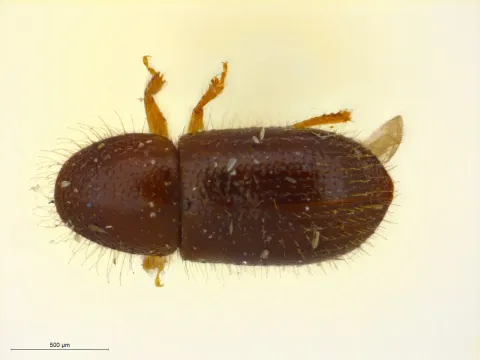
Poecilips is a genus of bark beetles (family Curculionidae, subfamily Scolytinae) that are recognized as significant pests for various plants and stored agricultural products.
What the section contains
Poecilips
The adult beetles are typically very small, ranging from 2 to 3 mm in length, and possess a cylindrical, robust body shape typical of the Scolytinae subfamily.
Their coloration is generally dark brown or black, often with a subtle, shiny, or slightly pubescent texture, which helps them camouflage within bark or seed tissues.
The development cycle of Poecilips is completed entirely inside the host plant material, where larvae feed and grow until they reach the pupation stage.
These insects prefer stable, high-humidity environments and moderate temperatures, which enable them to thrive both in tropical field conditions and in warehouse facilities.
Poecilips species are known to attack a wide range of hosts, including seeds of various tropical plants like coffee, as well as several woody ornamental species.
The larvae and adults cause severe damage by boring galleries deep into the tissues of fruits, seeds, or small stems, effectively destroying the internal structure of the plant part.
In seeds, the damage leads to total loss of germination potential, making the batch completely unsuitable for agricultural planting or consumption.
For woody plants, these beetles disrupt the vascular system, which weakens the plant's overall vigor and makes it highly susceptible to secondary pathogens.
During storage, the pest can multiply rapidly, leading to substantial economic losses if the environment provides the necessary moisture for their life cycle.
The most distinctive sign of a Poecilips infestation is the presence of tiny, pin-sized entrance holes on the surface of the bark, fruits, or seeds.
An accumulation of fine, powdery dust, known as frass, often appears around the entrance holes, indicating active boring activity by the beetles.
Infested plants often show signs of stunted growth, yellowing foliage, or premature branch wilting due to the disruption of internal transport systems.
In stored seeds, one might observe a decrease in the bulk density of the product and the presence of internal cavities if the seeds are sliced open.
Increased temperature in localized spots within a stored grain pile can sometimes indicate an active infestation and the buildup of insect populations.
Strict phytosanitary inspections of imported seeds and plant materials are the first line of defense to prevent the spread of this beetle to new regions.
Storage management is crucial, focusing on maintaining low humidity levels and adequate ventilation to create conditions unsuitable for Poecilips development.
In agricultural settings, the systematic removal and destruction of infested branches or crop debris serve as an effective way to reduce the overwintering population.
Chemical control using insecticides may be applied during the beetle's flight period, but it must be integrated with other management practices to be successful.
- Use of pheromone traps for early detection and population monitoring.
- Fumigation of infected storehouses using approved professional methods.
- Regular cleaning of post-harvest equipment to remove residual infestation.