
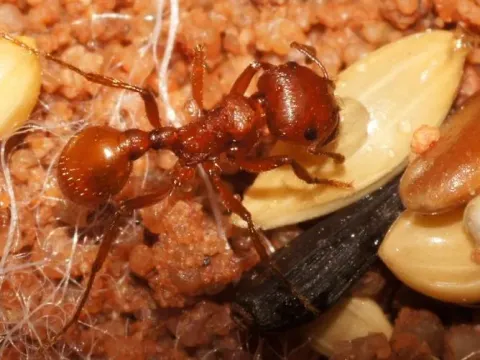
Pogonomyrmex humilis
Pogonomyrmex humilis
Pogonomyrmex humilis is a harvester ant species belonging to the Formicidae family and the Myrmicinae subfamily. These insects are well-adapted to survive in arid environments and are known for their distinct social structure and foraging habits.
What the section contains
Pogonomyrmex humilis
They can be identified by their appearance: medium-sized ants with a robust body, ranging from reddish-brown to dark brown in color. Their morphology is optimized for digging and transporting heavy objects, such as seeds, back to the colony.
The nests are typically constructed in the soil and are often characterized by a crater-like entrance surrounded by debris, sand, and husks. These features make them relatively easy to spot on open agricultural fields.
Taxonomically, they are part of the order Hymenoptera. Their biological success is rooted in a highly organized colony structure, where worker ants are dedicated to foraging, brood care, and nest maintenance throughout the growing season.
The lifecycle includes a complete metamorphosis from egg to larva, pupa, and finally adult. The colonies are perennial and can grow quite large, allowing them to exert significant pressure on local vegetation and seed resources.
The primary agricultural damage caused by Pogonomyrmex humilis is the massive collection and consumption of seeds. They can remove large quantities of sown seeds from the soil, leading to poor crop stands and economic losses.
Cereal and pulse crops are particularly vulnerable to these pests. Ants are capable of locating and digging up planted seeds, which necessitates reseeding on affected field sections, increasing production costs.
Beyond seed loss, their tunneling activities in the soil can damage the root systems of young seedlings. By loosening the earth around the roots, they stress the plants and make them more susceptible to drought and pathogen entry.
Infestations often result in uneven plant density across the field. This heterogeneity complicates field management and can lead to a reduction in overall harvest quality and quantity.
In high-density scenarios, these ants can strip entire areas of seeds, resulting in significant yield depletion. Their role as seed predators makes them a persistent threat to agricultural stability in affected regions.
The activity of Pogonomyrmex humilis begins in the spring when soil temperatures reach favorable levels. As the colony emerges from its winter state, worker ants immediately start foraging for available seeds to support the brood.
During the summer, the ants adjust their activity cycles to avoid extreme heat. Foraging usually peaks during cooler periods of the day, such as early mornings and late evenings, to maximize efficiency and survival.
Autumn marks a period of intensive seed collection, as the colony prepares to stockpile food reserves for the winter season. This often coincides with harvest times, where spilled grains become an easy target.
Winter brings a period of dormancy, with the ants remaining deep within the underground chambers of the nest. Metabolic processes slow down significantly until the return of warmer weather triggers the cycle once more.
The seasonality of these ants is deeply intertwined with the phenology of crops. Their highest impact occurs during critical windows of seed germination and crop maturation.
One of the most obvious signs of infestation is the presence of numerous anthills on the field surface. The entrances are often littered with grain husks and plant debris, indicating successful harvesting activity.
Patches of sparse or missing crops indicate areas where ants have successfully removed sown seeds. These "bare spots" are often accompanied by visible tunnels or disturbed soil structure in the root zone.
Well-defined trails leading from the nests to foraging sites are a clear indicator of a thriving colony. These trails can often be followed to locate the primary nest sites within or near the fields.
Young plants may show signs of premature wilting or stunting due to root damage caused by nest construction activities. This symptom is frequently mistaken for localized drought stress or soil diseases.
The accumulation of sand or small gravel particles in a ring around the nest hole is a diagnostic feature. Observing these structures helps agronomists locate infestations early before widespread damage occurs.
The most effective preventative measure is the treatment of seeds with systemic insecticides before planting. This creates a protective barrier around the seed, deterring ants from collecting and removing them from the soil.
For established colonies, the use of targeted insecticide baits placed near nest entrances is recommended. These baits are carried into the nest, effectively targeting the queen and reducing the entire colony population.
Deep mechanical tillage, performed either in autumn or spring, disrupts the nest structure. This physical disturbance forces the colony to relocate or leads to significant mortality among the brood due to microclimate disruption.
Applying granular insecticides directly to the seed furrow during sowing provides a temporary shield for germinating seeds, which is crucial for establishing a uniform crop stand despite ant activity.
Regular field scouting and monitoring are essential to catch infestations in the early stages. Localized spot treatments can prevent the spread of the colony and significantly reduce the need for field-wide chemical applications.