
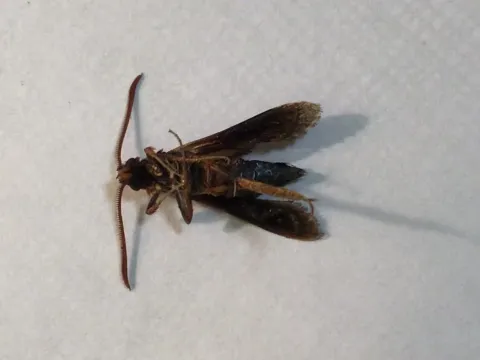
Lilac borer
Podosesia syringae
The lilac borer (Podosesia syringae) is a clearwing moth belonging to the family Sesiidae. Adult moths mimic wasps or hornets, featuring transparent wings and yellow-banded abdomens to deter predators.
What the section contains
Lilac borer
The adult moth has a wingspan of approximately 30 to 40 millimeters. Despite their wasp-like appearance, they are harmless to humans and are strictly diurnal, preferring to fly during bright sunny hours.
The larvae are creamy-white, cylindrical, and possess a distinct dark-brown head capsule. These caterpillars are specialized borers that spend their entire development phase deep inside the woody tissues of the host plant.
Their life cycle typically spans one year in warmer climates, though it may take two years in cooler regions. Development includes four distinct stages: egg, larva, pupa, and adult.
Due to their cryptic internal feeding habit, identifying these pests in the early stages of infestation is challenging, often requiring careful observation of the plant bark.
The lilac borer primarily attacks members of the Oleaceae family. Their favorite hosts include lilac (Syringa), ash (Fraxinus), and privet (Ligustrum), which are commonly used in landscape design.
Larvae cause damage by tunneling into the phloem and xylem of the trunks and branches. This tunneling disrupts the plant's vascular system, hindering the transport of water and nutrients.
Severe infestations often result in branch dieback or the death of the entire plant. In young saplings, the larvae can girdle the trunk, causing the tree to collapse or dry out entirely.
Besides direct physical damage, the tunnels created by the larvae serve as entry points for pathogens, including wood-decay fungi and harmful bacteria that further weaken the tree's structure.
Large trees may tolerate moderate infestations for several years, but their vigor significantly declines, leading to stunted foliage and premature leaf drop during the summer months.
Adult moths emerge from pupae in late spring and early summer. The exact timing varies significantly depending on the local climate and temperature accumulation throughout the season.
Females lay eggs in bark crevices or near existing wounds on the trunks of host trees. A single female can lay several hundred eggs, ensuring the continuation of the population.
Once the eggs hatch, the larvae bore through the bark and begin feeding on the cambium layer. They remain active throughout the summer and fall, gradually moving deeper into the wood.
During the winter, the larvae go into a dormant state within their tunnels. They resume feeding in the early spring, increasing their size rapidly before they prepare for the pupal stage.
The pupal stage occurs inside the tunnel near the exit hole. As the moth prepares to emerge, the pupa moves partially out of the exit hole, facilitating the release of the adult.
The most reliable sign of an infestation is the presence of small, round exit holes on the trunk or large branches. These holes are roughly the diameter of a pencil lead.
Coarse sawdust or frass often accumulates near the base of the tree or at the entry point of the tunnels. This material is a mix of wood debris and larval excrement.
Discolored, sunken, or cracked bark around the entrance holes is a common indicator of underlying larval activity. Sometimes, sap may ooze from these wounds as the tree attempts to seal itself.
Empty pupal skins, which are light brown and papery, can often be found protruding from the exit holes after the moths have successfully emerged from the wood.
Wilting, yellowing, or thinning of the canopy is a late-stage symptom, signaling that the structural integrity of the main trunk has been significantly compromised by the borers.
Sanitation is the most effective management strategy. Pruning and removing infested branches or entire dying trees helps reduce the local population of the pest significantly.
Pheromone traps are excellent tools for monitoring the population and determining the exact timing of adult activity, which is crucial for the success of any chemical intervention.
If chemical control is necessary, residual insecticides can be applied to the bark of the trunks during the peak egg-laying period to prevent the larvae from successfully entering the wood.
Maintaining tree health through proper irrigation, mulching, and fertilization is essential. Strong, healthy trees are less likely to be selected by egg-laying females for infestation.
For high-value specimen trees, systemic insecticides or professional trunk injection techniques can provide a higher level of protection against existing larval populations.