
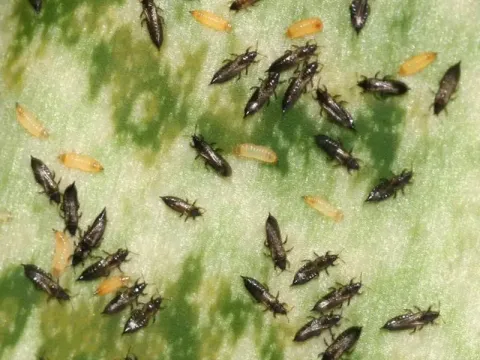
Lily thrips
Liothrips hradecenis
The lily thrips (Liothrips hradecenis) is a tiny insect belonging to the order Thysanoptera and the family Phlaeothripidae. Adult specimens typically reach 2–3 mm in length and feature an elongated, dark brown or black body.
What the section contains
Lily thrips
They possess mouthparts specifically adapted for piercing and sucking plant juices. While they have narrow wings with a characteristic fringe, they are rarely seen flying and prefer to live in hidden, secluded areas within plant bulbs or leaf axils.
The biological cycle consists of an egg stage, two larval stages, prepupal and pupal stages, and the adult stage. The speed of their development is highly temperature-dependent, with warmer weather significantly accelerating reproduction cycles.
These pests primarily overwinter as adults in the soil, among plant debris, or nestled within the scales of lily bulbs stored for winter. As spring temperatures rise, they emerge to begin feeding and laying eggs.
Lily thrips are notoriously cryptic, avoiding direct sunlight and residing in dense, inaccessible areas like leaf bases or tightly packed bulb layers, which makes early identification challenging.
The primary hosts for this pest are ornamental bulbous plants, most notably various species and hybrids of lilies. Under conditions of high population density, they may occasionally impact other related ornamental crops.
The pests feed on the sap of young shoots, buds, and bulb scales, which leads to the severe weakening of the plant. Damage sustained during the growing season or during storage is particularly devastating.
The feeding sites created by the thrips act as entry points for secondary infections, such as fungal and bacterial rots. Consequently, infested bulbs often decay rapidly and lose their viability.
Ornamental quality is significantly impaired: foliage becomes deformed, buds may fail to open or drop prematurely, and the plant exhibits a stunted, chlorotic appearance.
If left unchecked, a thriving colony can completely destroy a lily bed within one or two growing seasons by draining the bulb's energy reserves and compromising the root system.
The earliest signs of an infestation include the distortion and twisting of young lily shoots. Leaves may show silvery streaks or patches that eventually turn brown and necrotic over time.
Bud inspections often reveal stunted growth, premature drying, and failure to bloom. Flowers, if they do open, are frequently asymmetrical, malformed, or discolored.
When inspecting bulbs, one may find characteristic dark excrement spots and multiple tiny puncture marks on the scales. These areas often appear bleached, dry, and brittle.
In hot, dry weather, pest activity increases, leading to widespread yellowing of the foliage, which is frequently misidentified by gardeners as a simple drought or nutrient deficiency.
- Silvery streaks appearing on foliage.
- Twisted flower stems and deformed flower buds.
- Dark excrement spots found on bulb scales.
- General plant stunting and premature wilting.
- Development of bulb rot in areas damaged by insect feeding.
Managing this pest requires an integrated approach that combines cultural practices and chemical intervention. It is crucial to enforce strict quarantine of new bulb stock and perform thorough inspections before planting.
Soaking bulbs in systemic insecticide solutions before planting or placing them into winter storage is highly effective for eliminating hidden populations tucked between the scales.
Regular weeding of the lily garden eliminates alternative habitats and food sources, significantly reducing the pest's ability to thrive. Implementing crop rotation helps prevent the long-term buildup of thrips populations in the soil.
During the growing season, if an infestation is detected, spraying with systemic insecticides is necessary. Treatments should be applied at 7–10 day intervals to disrupt the insect's life cycle and target emerging generations.
In storage facilities, maintaining proper humidity and cooler temperatures is essential, as dry, warm conditions significantly favor the rapid reproduction of thrips within the stored bulbs.