
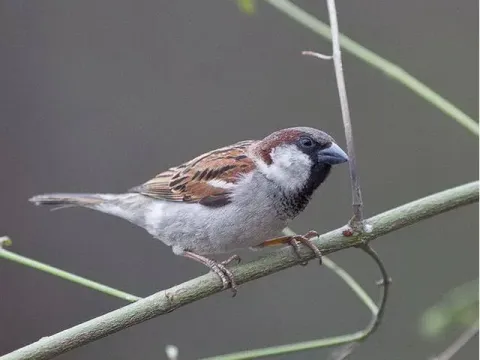
House sparrow
Ploceus domesticus
The House sparrow (Passer domesticus) belongs to the order Passeriformes and the family Passeridae. It is a highly social bird species that typically inhabits agricultural and urban landscapes.
What the section contains
House sparrow
The bird has a sturdy body, a short and strong conical beak adapted for cracking seeds, and a characteristic appearance that allows for easy recognition in flocks.
Males possess a distinctive black bib, grey crown, and chestnut markings on the back, while females exhibit a plain brown and grey plumage for better camouflage.
Their biological success is due to high breeding rates, with females often raising multiple broods per season, leading to rapidly increasing population numbers.
These birds are opportunistic feeders, showing remarkable intelligence in locating food sources within agricultural settings, which directly impacts crop yields.
Sparrows cause significant damage to cereal crops by feeding on developing grains, specifically during the milk and dough stages of wheat, barley, and oats.
In orchards and vineyards, they are known for consuming fruit buds during early spring and pecking at ripening grapes, cherries, and other soft fruits.
Sunflowers are heavily affected as well, with sparrows systematically eating seeds from the heads, which leads to substantial losses in harvested seed volume.
At grain storage facilities and drying floors, sparrows not only consume large quantities of stored product but also contaminate it with feces, feathers, and grit.
Vegetable crops are also at risk, as sparrows frequently pull up seedlings or damage young leaves to satisfy their need for moisture during dry weather.
The peak activity of house sparrows in fields occurs during the ripening phase of cereals, typically from mid-summer until the completion of harvest.
In early spring, when natural food is scarce, the birds concentrate in orchards, causing damage to dormant buds and thus reducing the potential fruit harvest.
During autumn and winter, populations often migrate toward farm buildings, feedlots, and storage silos, maintaining constant pressure on post-harvest assets.
The winter period is crucial for their survival, leading to high densities around livestock farms where they exploit grain spillage and animal feed waste.
The seasonal movement of sparrow flocks across the agro-ecosystem necessitates year-round observation and the implementation of protective protocols.
A primary indicator of infestation is the presence of large, noisy flocks congregating on the edges of fields near hedgerows or farm structures.
On grain crops, visual signs include stripped ears, scattered chaff, and broken stalks where the birds have perched to feed on the grain.
In vineyards or orchards, evidence includes peck marks on fruit surfaces and a visible layer of damaged buds or discarded fruit skins underneath the canopy.
Inside storage buildings, the presence is marked by droppings, accumulated debris, and damage to packaging or ventilation screens from repeated entry.
Sunflowers that have been scavenged will show damaged or completely empty seed heads, indicating active foraging by sparrows in the immediate area.
Acoustic deterrents that broadcast predator calls or distress signals are among the most effective ways to discourage sparrows from entering fields.
Visual deterrents such as reflective tapes, spinning discs, and bird-of-prey silhouettes can provide temporary relief in smaller horticultural plots.
Physical exclusion remains the most reliable method, using netting over vineyards and small vegetable patches to prevent direct access to the crops.
For storage facilities, it is vital to secure all entry points, such as windows and vents, using fine-gauge wire mesh to exclude the birds completely.
Good agricultural practices, such as ensuring rapid harvesting and cleaning up spilled grain, significantly reduce the attractiveness of fields to sparrow flocks.