
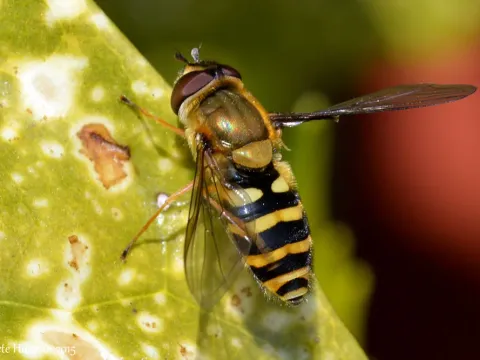
Hoverfly
Syrphus yalinatus
The hoverfly, scientifically known as Syrphus ribesii, belongs to the family Syrphidae within the order Diptera. These insects are famous for their mimicry, as their yellow and black abdominal patterns closely resemble those of wasps or bees.
What the section contains
Hoverfly
Adult hoverflies are easily identified by their unique flight pattern, characterized by the ability to hover stationary in mid-air before darting away. This behaviour makes them excellent pollinators for a wide range of horticultural crops.
The larvae, often called 'aphid lions', have a slug-like appearance without defined heads or legs. They are usually greenish, brownish, or yellowish, allowing them to blend perfectly with plant foliage while hunting.
Measuring around 10–12 mm, the adult flies are harmless to humans and are attracted to garden flowers rich in nectar and pollen, which serve as their primary energy source throughout their life cycle.
As members of the Syrphidae family, they play a dual role in ecosystems: adults facilitate pollination, while larvae act as major natural predators of aphid populations in various habitats.
Syrphus ribesii is not a pest; on the contrary, it is one of the most valuable allies for farmers and gardeners. Their larvae consume large quantities of aphids, which are common sap-sucking pests that stunt plant growth.
These predatory larvae do not damage plant tissues; instead, they provide essential biological control by reducing pest density. A single larva can consume hundreds of aphids during its short development phase.
Unlike some other insect species, hoverfly larvae focus their feeding habits on pests, preventing the spread of secondary plant infections that usually follow aphid colonization and leaf damage.
By keeping aphid populations below the economic injury level, hoverflies minimize the need for synthetic chemical interventions, making them a cornerstone of integrated pest management strategies.
Farmers should consider the presence of these larvae as a positive indicator of crop health and environmental balance, avoiding any actions that might jeopardize this natural pest suppression.
Hoverfly activity typically begins in late spring when temperatures rise. As the weather warms, adult flies emerge to mate and seek nectar sources, followed by the appearance of the first generation of larvae.
Depending on the climatic zone, there can be multiple overlapping generations throughout the growing season. The cycle from egg-laying to adult emergence is relatively short, usually lasting about three to four weeks.
Eggs are laid by females on the undersides of leaves or near aphid colonies. This strategic placement ensures that neonate larvae have immediate access to food, maximizing their survival rate during the critical early stages.
Development involves several larval instars, culminating in pupation, which often occurs in the soil or protected areas near the host plants. This life stage is vital for surviving adverse conditions between generations.
Overwintering usually takes place in the pupal stage, often sheltered in leaf litter or topsoil. Maintaining ground cover and protecting undisturbed soil areas are crucial for ensuring the survival of the next year's population.
The most prominent sign of hoverfly activity is a natural decline in aphid colonies without the application of insecticides. Finding small, slug-like larvae crawling among aphid clusters is a clear indicator of successful biological control.
Observing adult flies hovering over flowering garden beds or field crops is a sign of a healthy ecosystem. Their presence usually correlates with a lower frequency of aphid-related plant deformities.
Healthy, vigorous growth of young shoots, free from the curling typically caused by sap-sucking pests, serves as a testament to the efficient work of these predatory larvae.
Visible remains of aphid carcasses and clean plant stems are further evidence of predation. When combined with adult sightings, these signs confirm that the hoverflies are actively suppressing pest pressure.
If aphids are present but remain at low levels that do not impact harvest quality, the hoverflies are successfully doing their job, reducing the need for costly and harmful chemical sprays.
To encourage hoverflies, create flower-rich environments. Planting nectar-rich flowers like dill, coriander, marigolds, and alyssum provides the essential nutrients adults need to fuel their flight and reproduction.
Minimize the use of broad-spectrum pesticides, as these chemicals are highly toxic to hoverflies. If pest outbreaks necessitate chemical intervention, choose selective, biorational products that spare beneficial insects.
- Establish wildflower corridors around field edges.
- Reduce tillage to protect overwintering pupae.
- Use biological preparations that target only the specific pest.
- Schedule any necessary sprays for late evening when activity is low.
Integrated Pest Management (IPM) relies on protecting these beneficial organisms. Promoting a diverse habitat is the most effective way to sustain the hoverfly population throughout the season.
By adopting sustainable agricultural practices, farmers can rely on the natural efficiency of Syrphus ribesii to protect their crops, leading to both economic and ecological benefits.