
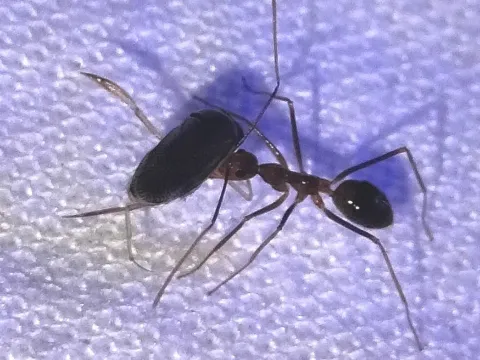
Longhorn crazy ant
Plagiolepis longipes
The longhorn crazy ant (Anoplolepis gracilipes) is a notorious invasive species known for its erratic, frenzied movement patterns when disturbed.
What the section contains
Longhorn crazy ant
Adult workers are yellowish-brown, approximately 4–5 mm long, with disproportionately long legs and antennae that give them a distinct appearance.
These ants lack a stinger; instead, they spray formic acid to incapacitate prey or defend their nest, which causes irritation to other insects and organisms.
They are polygynous, forming huge supercolonies with multiple queens, which makes them extremely resilient and difficult to eradicate from agricultural lands.
They do not build complex mound nests but prefer nesting in soil, under debris, in decaying wood, or within natural crevices of plants and buildings.
While they do not consume plant tissues directly, they are significant agricultural pests due to their mutualistic relationship with honeydew-producing insects.
They vigorously protect sap-sucking pests such as aphids, scale insects, and mealybugs from their natural predators, allowing these pests to proliferate unchecked.
The resulting explosion in the population of sap-sucking insects leads to significant plant stress, stunted growth, and damage to flowers and fruit development.
The accumulation of honeydew secreted by these pests promotes the growth of sooty mold, which coats leaves and blocks sunlight, further reducing photosynthetic efficiency.
In severe cases, the combined damage of sap-sucking pests and sooty mold can lead to the decline and death of ornamental and crop plants.
As a tropical species, their activity is heavily dependent on favorable temperatures and moisture levels throughout the year.
They remain active during the warm months, with population levels peaking during seasons of consistent heat and high humidity.
During extreme drought or heat, colonies often retreat into the soil to seek moisture, reducing their visible activity on plant surfaces.
The reproductive phase and colony expansion are most intense during the growth season of agricultural crops, coinciding with the peak of aphid infestations.
In cooler climates, their metabolic rate slows down, but they can survive in protected microhabitats, waiting for environmental conditions to improve.
The most visible sign of infestation is the presence of frantic, disorganized trails of ants running up and down plant stems and tree trunks.
A noticeable increase in populations of aphids, mealybugs, or scale insects on plants is a primary indicator of ant-tended colonies.
Black sooty mold covering the foliage or stems is a classic symptom, indicating the presence of heavy honeydew secretions from sap-sucking pests.
A decline in the diversity and number of beneficial predatory insects (like ladybirds) suggests that the ants are actively excluding them from the area.
Visible damage such as leaf curling, chlorosis, and general plant weakness confirms that sap-sucking pests are currently exploiting the plant's resources.
Managing the longhorn crazy ant requires a strategy that targets both the ant colony itself and the sap-sucking insects they protect.
Slow-acting toxic baits are highly effective as workers transport the bait back to the nest, ultimately eliminating the queens and collapsing the colony.
Installing physical barriers like sticky traps on tree trunks stops ants from reaching the canopy, allowing natural predators to prey on the pests.
Systemic insecticides should be applied to manage the populations of aphids and scale insects, making the plant less attractive for ant foraging.
- Sanitation: Remove debris and nesting sites.
- Use of ant-specific bait stations.
- Integrated Pest Management (IPM) to protect natural enemies.