
Luteata Pug
Eupithecia luteata
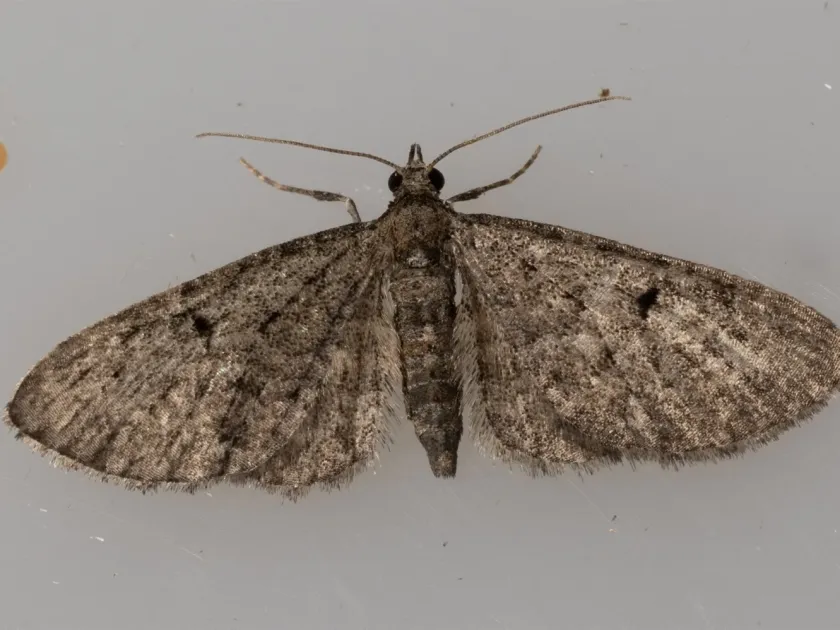
Description
How to identify
The Luteata Pug (Eupithecia luteata) is a moth belonging to the Geometridae family. These insects are well-adapted to coniferous environments and are common inhabitants of temperate forest zones.
Adult moths have a wingspan of approximately 20 mm. Their wings feature a cryptic coloration pattern consisting of brown, grey, and ochre lines, providing excellent camouflage against tree bark.
The larvae, or caterpillars, possess a slender body and typically exhibit green or brownish patterns that mimic pine or spruce needles, making them difficult to detect by sight.
The life cycle undergoes complete metamorphosis, including egg, larval, pupal, and adult stages. The species overwinters as a pupa, typically buried in the soil under the canopy of host trees.
Taxonomically, this species belongs to the genus Eupithecia, a group known for its diversity and difficulty in identification, containing numerous species that often occupy similar ecological niches.
What it damages
The primary hosts for the Luteata Pug include various coniferous species, most notably Spruce (Picea) and Larch (Larix). Larvae feed on the soft tissue of needles.
Feeding damage is usually concentrated on new growth. By consuming the needles, the caterpillars disrupt the tree's photosynthetic capacity, which can lead to reduced vigor and stunted growth.
Severe infestations in young plantations can cause significant damage to terminal buds, resulting in deformed crowns or, in extreme cases, the death of young seedlings.
While mature trees are generally more resilient, heavy defoliation by these larvae can stress the tree, making it susceptible to secondary infestations by bark beetles or wood-boring insects.
The economic impact is particularly felt in nursery settings and Christmas tree farms, where the cosmetic quality of the needles is of paramount importance for market value.
When it appears
Adult moths are typically active from late spring through the early part of summer. This timing is strategically aligned with the development of new foliage on host trees.
The larval stage is active during the summer months. During this time, they feed voraciously, increasing their biomass rapidly to prepare for the upcoming transition to the pupal stage.
As summer draws to a close, the larvae migrate toward the ground to pupate in the leaf litter or soil. This pupal state is the longest phase of their annual life cycle.
Climate factors such as early spring temperatures are critical, as they can cause moths to emerge earlier than usual, potentially misaligning their life cycle with the tree development.
Regular scouting throughout the summer season is necessary to detect and monitor population levels, especially following mild winters that favor insect survival.
Signs of infestation
Frass (larval droppings) is one of the most reliable indicators of an infestation. Small, dark, granular pellets can often be found accumulating on lower branches or the forest floor.
Look for needles that appear chewed or skeletonized. Larvae often leave the central vascular tissue of the needle intact, which can give the branch a mottled appearance.
The presence of fine webbing amongst the needles is another tell-tale sign of Luteata Pug activity, as the caterpillars use silk to secure themselves and their food source.
Branch tips that look scorched or dried out in the middle of summer often indicate that the developing buds were attacked during the early stages of larval development.
Manual inspection of foliage is effective; gently tapping branches over a light-colored sheet will often cause the well-camouflaged caterpillars to dislodge and fall.
Control measures
Biological control using Bacillus thuringiensis (Bt) is highly effective against young larvae while preserving beneficial insects and predators within the ecosystem.
In ornamental gardens, physical removal of infested branches can be an efficient way to reduce local populations, provided the tree is small enough for thorough inspection.
Chemical control should be reserved for high-threshold outbreaks and implemented with caution, ensuring that the chemicals are specifically approved for coniferous moth control.
Fostering biodiversity is a long-term solution. Promoting habitats for insectivorous birds and predatory wasps can significantly keep Luteata Pug populations in check naturally.
Using pheromone or light traps for monitoring allows land managers to pinpoint the timing of peak flight, enabling precise and timely interventions rather than indiscriminate spraying.
Discussion
No discussions yet — be the first.