
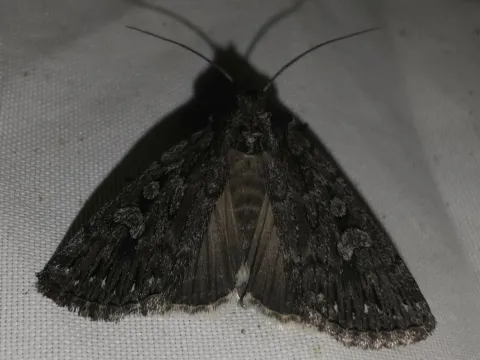
Loxagrotis
Loxagrotis
Loxagrotis is a genus belonging to the Noctuidae family within the order Lepidoptera, commonly associated with the cutworm group of agricultural pests.
What the section contains
Loxagrotis
Adult moths typically exhibit cryptic coloration, allowing them to blend into soil and debris, which serves as a protective mechanism during daylight hours.
The larvae are characterized by a cylindrical, segmented body with a well-defined head capsule, often displaying varying shades of grey or brown.
Like all moths, Loxagrotis undergoes a complete metamorphosis involving four distinct stages: egg, larva, pupa, and adult (imago).
These insects are highly adaptable, often selecting soil rich in organic matter for oviposition to ensure favorable conditions for the developing larvae.
These pests are generalists, feeding on a diverse range of crops including cereals, pulses, vegetables, and various industrial plant varieties.
The most significant damage occurs at the seedling stage, where larvae act as cutworms, severing the stems of young plants at ground level.
During the vegetative phase, feeding on leaves and buds significantly reduces the plant's photosynthetic area, directly impacting yield potential.
Fields of corn, sunflower, and various vegetable crops are highly susceptible to infestation, particularly in years with favorable environmental conditions.
Economic losses can be severe if early-season monitoring is neglected, as large populations can rapidly decimate a newly planted field.
A primary indicator of infestation is the sudden appearance of gaps or bare patches within a field, caused by seedlings being cut at the base.
Leaves of damaged plants often exhibit irregular feeding patterns, which can range from small notches to complete skeletonization.
The presence of larval frass (excrement) around the base of the plant or on the soil surface is a clear sign of active pest infestation.
Wilting of seemingly healthy plants during the day is often an indication of stem or root damage caused by subsurface larval activity.
During evening surveys, one may observe larvae actively feeding on foliage before they return to hide in the soil profile at dawn.
Strategic deep plowing is one of the most effective mechanical methods to disrupt the lifecycle by exposing pupae to predators and environmental extremes.
Rigorous weed management is essential, as many Loxagrotis species utilize weed hosts to maintain population levels between crop seasons.
The use of pheromone traps provides valuable data for timing control measures, ensuring that insecticides are applied only when necessary.
Biological control agents, such as entomopathogenic fungi and bacteria, offer a sustainable alternative for managing larval populations in integrated systems.
- Application of selective insecticides at threshold levels.
- Crop rotation to break the pest's reproductive cycle.
- Conservation of beneficial natural enemies like predatory beetles and birds.