
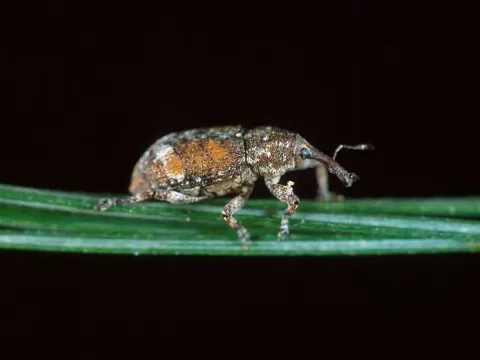
Engelmann spruce weevil
Pissodes engelmanni
The Engelmann spruce weevil Pissodes engelmanni is a serious pest belonging to the Curculionidae family. It specifically targets spruce species and is notorious for damaging young trees in North American forests.
What the section contains
Engelmann spruce weevil
Adult weevils are small, typically measuring between 5 to 7 mm in length. Their bodies display a reddish-brown coloration with distinct light-colored scales forming patches on the elytra, which provides camouflage.
The larvae are legless, white, and C-shaped, perfectly adapted for living under the bark of conifer leaders. They undergo several molting stages while feeding on the inner tissues of the host plant.
The prominent snout (rostrum) is a diagnostic feature used by the female to drill holes into the bark. This allows for precise egg deposition and provides a protected environment for the developing brood.
Adults are elusive and often remain inactive during the day, making them difficult to spot during routine inspections unless the observer knows exactly where to look for signs of feeding activity.
The primary hosts of the Engelmann spruce weevil are young spruce trees. It is particularly damaging to trees in the sapling stage that have not yet reached full maturity.
The weevil focuses its attack on the terminal leader. By feeding on the tissues under the bark, larvae girdle the leader, effectively cutting off the water and nutrient supply to the tree's top.
This disruption causes the leader to die back, which forces the tree to compensate by creating a new leading shoot from a side branch. This results in crooked or forked stems, ruining the tree's form.
Repeated attacks year after year can lead to severe stunting, drastically reducing the timber value and the growth potential of the affected spruce stands in forest plantations.
In high-density outbreaks, the weevil can cause widespread degradation of young forest ecosystems, making it a major concern for silviculturists and commercial forestry operations.
Adult activity begins in the early spring, triggered by the warming temperatures as they emerge from their overwintering sites in the duff or at the base of spruce trees.
Mating and egg-laying occur mainly in May and June. Females select the most vigorous terminal leaders of the current year to ensure an adequate food supply for their larvae.
Larval development takes place throughout the summer months. The insects progress through several instars, culminating in pupation within protective cells constructed beneath the bark of the leader.
By late summer or early autumn, the new generation of adults emerges. They chew small circular exit holes through the bark, signaling the completion of one generation cycle.
Emerging adults feed for a short period before seeking sheltered places to survive the winter, effectively remaining dormant until the next spring season initiates the cycle again.
The most recognizable symptom of infestation is the drooping of the terminal leader, which often curls into a shape resembling a shepherd's crook during the early summer months.
Resin beads or small droplets appearing on the surface of the leader are indicative of adult feeding or egg-laying punctures made by the female weevil during the spring.
When the bark of a symptomatic leader is peeled back, one can find galleries filled with frass, as well as the white larvae or the pupal chambers where transformation occurred.
In late summer, small, round exit holes become visible on the leader. These holes are clear evidence that the new adult weevils have already emerged from the host plant.
As the season progresses, the foliage on the affected leader turns yellow and eventually reddish-brown, marking the terminal death of the shoot as the vascular system fails.
Early detection is crucial for the management of this pest. Regular monitoring of young spruce stands during the spring allows for the identification of affected leaders before adults emerge.
Pruning and destroying the infested terminal leaders is the most effective mechanical control method. This must be done before the new generation of adults leaves the leader.
Chemical control involving systemic or contact insecticides can be applied during the spring to protect the leaders of young trees in high-risk plantation areas.
- Implementing pheromone traps for population monitoring.
- Promoting the growth of mixed forests to reduce host density.
- Encouraging natural predators such as birds and beneficial insects.
Selecting resistant varieties of spruce and planting at appropriate densities can significantly mitigate the long-term impact of the Engelmann spruce weevil on forest health.