
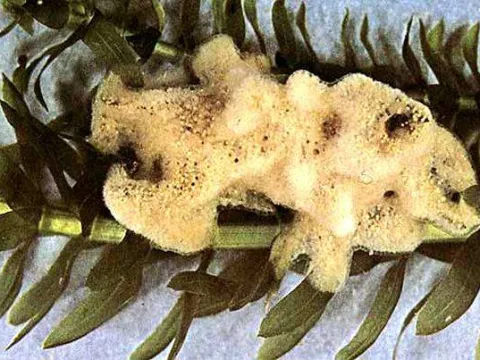
Ephydatia lacustris
Ephydatia lacustris
Ephydatia lacustris is a species of freshwater sponge belonging to the order Spongillida and the family Spongillidae. It forms colonies that attach to submerged surfaces, typically showing green, brown, or yellowish-grey hues.
What the section contains
Ephydatia lacustris
The body of the sponge is characterized by a complex system of canals and chambers that circulate water. Its texture can range from soft and friable to hard and compact, depending on the environmental conditions and the age of the colony.
A defining feature of the species is its skeleton made of siliceous spicules. Under microscopic examination, these needle-like structures are essential for identifying the sponge against other aquatic debris.
Reproduction occurs through both sexual means and the formation of gemmules. These dormant buds are highly resistant to extreme conditions, including freezing and desiccation, allowing the species to survive in varied environments.
The adaptability of Ephydatia lacustris to different flow rates and light levels makes it a resilient organism that can thrive in various agricultural water management systems.
The primary damage caused by Ephydatia lacustris occurs in industrial hydroponic setups and drip irrigation systems drawing water from open reservoirs. Sponges actively colonize the inner walls of pipes.
By growing inside pipelines, the sponge colonies reduce the cross-sectional area of the conduits, leading to a significant drop in water pressure and uneven nutrient solution distribution to the crops.
Sponges can clog filters and pump inlets, causing equipment to malfunction and leading to frequent system downtimes for mechanical cleaning and maintenance.
The metabolic activities of the sponges can alter the chemistry of the water. These changes can negatively affect the root zone health and the overall development of sensitive greenhouse crops.
When large colonies die within a closed system, they release organic waste products, creating an ideal environment for secondary bacterial and fungal pathogens to proliferate, threatening crop health.
Active growth of Ephydatia lacustris typically begins when water temperatures rise above 10–12 degrees Celsius. The peak developmental phase occurs during the summer months when environmental conditions are most stable.
In autumn, as temperatures drop and daylight decreases, the sponge colonies form gemmules. These dormant structures protect the organism throughout the winter, waiting for the return of favorable conditions.
In climate-controlled greenhouse environments, the seasonal cycle can be disrupted. If water temperatures are kept consistently warm, the sponge can continue its growth cycle year-round.
The development cycle is heavily dependent on the water source temperature. Agronomists should track seasonal water temperature changes to predict potential spikes in sponge activity within their systems.
Even in winter, gemmules can remain present within the system infrastructure, acting as a reservoir for new colonies once the irrigation water starts to warm up in the spring.
The first indicator of an infestation is a gradual decrease in water pressure at the drip emitters, which cannot be explained by standard sediment or mineral buildup.
During routine inspections, if slimy or rubbery growth with a distinctive marshy odor is found inside intake filters, it is a strong sign of a sponge colonization.
The presence of small, sand-like yellowish or brown granules in the water lines often indicates the fragmentation of a colony or the release of gemmules into the irrigation network.
Unexpected turbidity or shifts in the pH of the nutrient solution often indicate that sponge colonies are filtering the water and modifying its chemical composition within the dark areas of the system.
Rough patches on the inner surfaces of reservoir walls or pipes, which flake off to reveal a network of fibers when scraped, are characteristic signs of established sponge colonies.
Implementing multi-stage filtration systems at the water intake is the most effective preventive measure to stop gemmules and sponge fragments from entering the system.
Regular flushing of irrigation lines with high-temperature water or approved agricultural disinfectants can effectively eradicate colonies without damaging the integrity of the piping materials.
Excluding light from reservoirs and pipes is a crucial management strategy, as it hinders the growth of photosynthetic symbionts within the sponge, significantly slowing its development.
Mechanical cleaning using specialized pipe brushes is necessary for severe infestations. Following physical removal, the system should be thoroughly disinfected to prevent reinfection.
- Installing fine-mesh filters at the water source intake.
- Conducting regular inspections of filters for organic growth.
- Ensuring complete light isolation for all irrigation storage tanks and piping.