
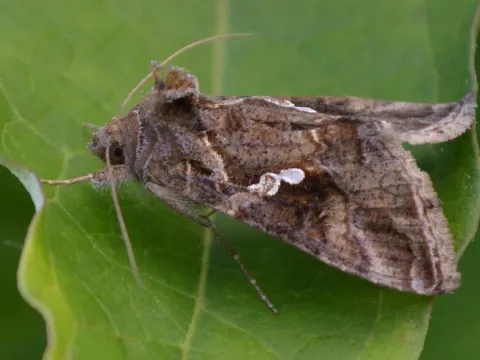
Oo moth
Phytometra oo
The Oo moth (Phytometra oo) belongs to the Noctuidae family, order Lepidoptera. The adult moth is of medium size, distinguished by a specific pattern on the forewings resembling the letters "oo" or digits, which gives the species its common name.
What the section contains
Oo moth
The adult's body is covered with dense hair, with coloration ranging from grayish-brown to ochre hues, providing excellent camouflage against vegetation. The hindwings are usually lighter than the forewings, often featuring a dark border along the outer edge.
The larva (caterpillar) has a typical noctuid appearance, equipped with three pairs of thoracic legs and five pairs of prolegs, allowing for active movement along plant stems.
Larval coloration is often green or brownish, helping them blend with the leaf surface, thus avoiding detection by natural predators or during field inspections.
The pupa is enclosed in a loose silken cocoon, which the caterpillar spins among leaves or within the top layer of the soil. The pupation process is a critical developmental stage that determines population survival.
This species is a polyphage; however, it causes the most damage to members of the Fabaceae and Polygonaceae families, as well as several weeds. Caterpillars feed primarily on leaves, skeletonizing them in early developmental stages.
Once they reach later instars, the larvae can consume the entire leaf blade, leaving only tough veins behind, which sharply reduces the plant's photosynthetic activity and stunts its growth.
Damage also occurs to reproductive organs, such as buds, flowers, and young pods, directly leading to yield losses and reduced quality of agricultural produce.
Feeding intensity depends on temperature and air humidity; therefore, in dry years with hot summers, the pest's harmfulness can increase due to accelerated metabolism.
Mass outbreaks on large acreages can lead to significant economic losses, requiring urgent agronomic intervention to prevent severe defoliation of crops.
The flight of the adult moths begins in late spring and continues through the first half of summer, coinciding with the active growth period of most field crops.
The adults are primarily nocturnal or crepuscular. During the day, moths prefer to hide within dense foliage or plant debris, making them difficult to detect during standard field assessments.
The egg-laying period is extended, meaning caterpillars of different ages are often found in fields simultaneously, complicating the timing of chemical control applications.
The overwintering stage is the pupa, which remains in the soil substrate or inside tightly curled leaves, resistant to low winter temperatures.
The emergence of adults in spring begins when soil and air temperatures exceed a specific threshold, triggering the development cycle of the new generation.
The first sign of infestation is the appearance of characteristic "windows" or irregular holes in young leaves, which gradually grow in size over time.
The presence of larval excrement in the form of small dark granules on leaf surfaces or beneath the plant is a reliable indicator of active pest presence in the area.
Damaged plant parts wither rapidly, and in cases of heavy infestation, one may observe "scorching" of leaf edges due to the disruption of water transport in damaged tissues.
In the evening, moths can be attracted to light sources, a behavior often utilized by agronomists to monitor population density using light traps.
The presence of webbing at feeding sites indicates that the larvae are preparing for pupation or molting, confirming the current developmental phase of the pest.
Agronomic protection methods include deep autumn plowing, which helps destroy a significant portion of pupae overwintering in the top layers of the soil.
Timely removal of weeds in fields and surrounding areas eliminates the pest's alternative food source during the off-season, reducing the total population for the following year.
Biological control involves the use of insecticides based on Bacillus thuringiensis, which are effective against young-instar larvae while remaining safe for beneficial insects.
Chemical protection of crops is implemented using systemic and contact insecticides when the economic threshold is exceeded, typically defined as 2–3 caterpillars per square meter.
It is recommended to rotate insecticides from different chemical groups to prevent the buildup of resistance in the Oo moth population to active pesticide ingredients.