
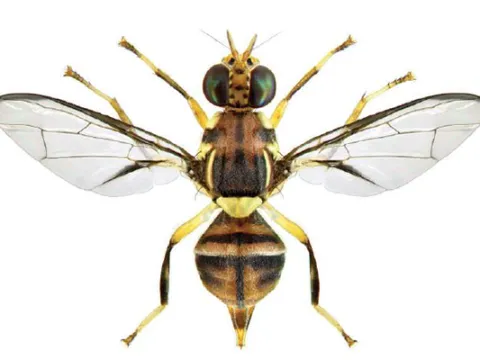
Oriental Fruit Fly
Dacus ferrugineus
The Oriental Fruit Fly, scientifically known as Bactrocera dorsalis, is a highly destructive insect belonging to the order Diptera and the family Tephritidae. It is considered one of the most significant agricultural pests globally.
What the section contains
Oriental Fruit Fly
Adult flies are approximately 8 mm in length, characterized by a dark body with distinctive yellow markings on the thorax and abdomen. Their wings are transparent with a thin, dark costal band along the leading edge.
The larvae are typical of the fruit fly family, exhibiting a cylindrical, tapering shape. Their color ranges from creamy white to pale yellow, and they possess the ability to move rapidly when disturbed.
This species is noted for its exceptional adaptability to various climates and environments. Its ability to thrive in diverse ecological niches has facilitated its rapid spread across many international borders.
Due to its potential for total crop destruction, it is classified as a high-priority quarantine pest in many countries, necessitating rigorous inspection of imported fresh produce.
The Oriental Fruit Fly is a major polyphagous pest, with host records including over 150 varieties of fruits and vegetables. It is particularly devastating to commercial plantations of tropical and subtropical fruits.
Primary hosts include mango, papaya, guava, and citrus fruits. It also frequently attacks stone fruits, such as peaches and apricots, causing significant economic losses for growers.
Females use their ovipositor to pierce the surface of the fruit and deposit eggs into the flesh. These punctures become entry points for secondary bacterial and fungal infections.
Upon hatching, the larvae tunnel through the fruit, feeding on the pulp. This internal feeding turns the fruit into a decaying mass, making it completely inedible and unfit for market.
Heavy infestations lead to widespread premature fruit drop and significant reduction in marketable yield. In unmanaged orchards, the level of infestation can easily reach 100%.
The development and activity of this pest are highly dependent on favorable temperatures. Optimal conditions for its life cycle are provided by temperatures between 25 and 30 degrees Celsius with high humidity.
In tropical conditions, the life cycle from egg to adult can be completed in as little as 20 to 30 days, allowing for multiple overlapping generations throughout the year.
Adult fly activity typically peaks during the ripening stage of the fruit. This is when the trees are most vulnerable to oviposition and subsequent larval infestation.
The pest does not typically hibernate in the traditional sense but rather slows down its activity during cooler periods, resuming rapid reproduction as soon as the weather warms up.
The high reproductive rate ensures that even a small initial population can quickly escalate into a massive outbreak, particularly in the presence of preferred host plants.
The most reliable sign of an infestation is the appearance of small, dark, circular punctures on the skin of the fruit, often surrounded by small areas of tissue softening or discoloration.
As the larvae feed internally, the fruit may appear soft to the touch and emit a fermented or rotten odor even before it shows external signs of decay.
When the infested fruit is cut open, one can observe the characteristic tunneling and the presence of white larvae within the decomposing pulp of the fruit.
In many cases, the fruit might look perfectly healthy from the outside, which is a major challenge for phytosanitary inspectors checking fruit shipments for export.
- Visible oviposition scars (small pin-prick holes).
- Soft, watery patches on the fruit surface.
- Premature fruit drop from the branches.
Strict quarantine measures are the first line of defense to prevent the movement of infested fruit into non-infested regions or countries.
Integrated Pest Management (IPM) strategies include the use of pheromone traps for monitoring populations and identifying the timing of peak adult activity.
Cultural control is essential, involving the regular collection and disposal of fallen fruit. Burying or destroying infested fruit helps to break the life cycle by killing larvae and pupae.
Chemical control often involves spot-spraying or using bait sprays, which combine an insecticide with a protein-based attractant to target the adult flies specifically.
The Sterile Insect Technique (SIT) is a highly effective, environmentally friendly method used to suppress large populations by releasing sterile males into the target area.