
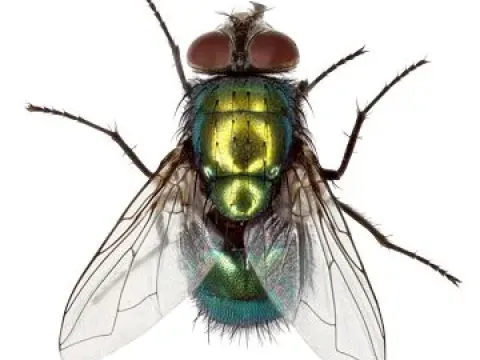
Bluebottle fly
Phormia groenlandica
The bluebottle fly, scientifically known as Phormia regina (often linked with Phormia groenlandica), belongs to the Calliphoridae family. Adult flies are easily recognized by their shiny, metallic blue or blue-green appearance.
What the section contains
Bluebottle fly
These insects grow to be 8–12 mm long. They possess large compound eyes and complex sensory organs that help them detect odors of decaying organic matter or fresh animal tissues from significant distances.
Their larvae, commonly known as maggots, are creamy-white, legless, and conical in shape. They are equipped with mouth hooks that they use to feed on decaying organic tissues effectively.
The life cycle consists of egg, three larval stages, pupa, and adult. The entire development from egg to adult is highly dependent on ambient temperature, often occurring within a few weeks in summer.
While often viewed as a sanitation pest, they play a specific role in natural ecosystems by breaking down animal carcasses, though their presence in agricultural storage is entirely undesirable.
Bluebottle flies do not harm plants directly but are major pests for meat, fish, and other protein-rich products in agricultural and food processing facilities.
The primary damage is caused by the larvae. Adult flies lay eggs on exposed protein sources, and the hatching larvae burrow into the product to feed, quickly destroying its structural integrity.
Feeding larvae secrete enzymes that break down the host tissue, causing rapid decomposition and foul odors. This renders the affected products unsafe for human or animal consumption.
Besides direct damage, these flies are mechanical vectors for pathogens. By crawling over surfaces, they spread bacteria, fungi, and parasites, significantly increasing the risk of contamination.
Facilities suffer economic losses not only from ruined inventory but also from the high costs of disposal, sanitization, and regulatory penalties associated with fly infestations.
The activity of the bluebottle fly typically begins when temperatures rise above 10°C (50°F). Springtime marks the emergence of the first generation from overwintering sites.
Populations peak during the warm summer months when heat accelerates their metabolic processes, leading to shorter life cycles and more rapid reproduction rates for the species.
High levels of activity are often linked to agricultural operations like slaughtering or food manufacturing, which provide abundant egg-laying substrates for the flies.
As autumn arrives, adult activity declines. The flies seek protected areas such as wall voids, basements, or unheated storage rooms to enter diapause for the colder months.
Indoor environments with stable temperatures, such as warehouses or processing plants, can support fly reproduction year-round if proper structural and sanitation controls are not maintained.
The most obvious sign of an infestation is the presence of adult flies buzzing around production areas or storage zones. Their metallic color makes them easy to spot.
Egg clusters are another indicator. Small, white, elongated eggs are often deposited in groups within the crevices or folds of meat and fish products, indicating an immediate infestation risk.
The presence of larvae inside food products or waste containers is a definitive sign. Larvae create characteristic softening of the tissue and a strong smell of decay.
Dark fecal spots on equipment, walls, or packaging indicate that adults have been resting in the area for some time, likely contaminating surfaces with pathogens.
Finding empty pupal cases in corners or near waste collection points confirms that at least one generation has successfully completed its life cycle within the facility.
Effective control starts with exclusion. Installing fine-mesh screens on all windows and doors is essential to prevent flies from entering food processing and storage buildings.
Sanitation is the most critical management tool. All organic waste must be disposed of daily, and all food products must be kept in airtight containers to prevent access for egg-laying.
Light-based traps (fly killers) with glue boards are excellent for indoor monitoring and controlling adult fly populations without using harmful chemical sprays around food.
For severe infestations, professional insecticide treatments may be necessary. These should be applied only by certified personnel and strictly according to food safety regulations.
- Use air curtains at main entrances to deter fly entry.
- Perform regular deep cleaning of all machinery and surfaces.
- Implement pheromone traps for early population detection.
- Store all protein materials in refrigerated areas below 5°C.