
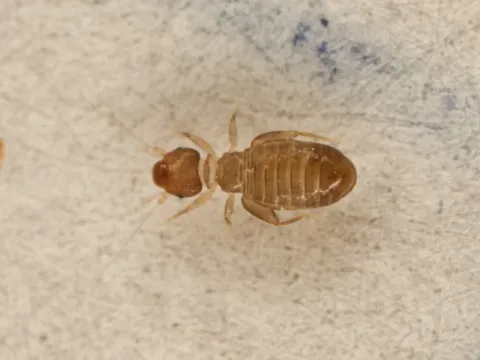
Booklouse
Liposcelis subfuscus
The booklouse (Liposcelis subfuscus) is a tiny insect belonging to the order Psocoptera and the family Liposcelididae. Adults are typically about 1 mm long, with flattened bodies and a brown to light-tan coloration that allows them to blend in with dust and grain.
What the section contains
Booklouse
A key distinguishing feature of this species is its wingless nature, as adults do not develop wings. They possess biting mouthparts and long, filiform antennae, which they use to navigate and locate organic food sources within storage environments.
Their life cycle consists of egg, nymph, and adult stages. Development is rapid under optimal conditions, specifically at temperatures between 25-30 degrees Celsius and in environments with high relative humidity.
Nymphs resemble smaller versions of the adults but are lighter in color. They undergo several molts before reaching maturity, spending their entire lifespan within the grain mass or storage structures.
These insects are highly secretive, often hiding in cracks, crevices, and deep within grain piles, making them difficult to detect during the early stages of an infestation.
Booklice are primarily pests of stored grains, seeds, flour, and processed cereal products. They thrive particularly well in areas where mold or fungi have started to grow, as these microorganisms are a major part of their diet.
The primary damage they cause involves consuming the embryo of the seed, which significantly reduces the germination rate of seed stocks and degrades the overall quality of grain intended for human consumption.
By feeding on molds, they facilitate the spread of fungal spores throughout the storage facility. Furthermore, their presence promotes the self-heating of grain masses, creating a vicious cycle of favorable conditions for even more severe pests.
Heavy infestations result in substantial contamination of the product with excrement, cast skins, and dead insects, rendering the grain unfit for food processing standards and reducing its market value.
In industrial silos, a large population of booklice can lead to massive quality loss, as the grain becomes dusty and tainted by a distinct musty odor associated with fungal growth.
Booklice can be active throughout the entire year within storage facilities, provided that the microclimate remains conducive to their survival. They are not limited by seasonal changes if the indoor climate is managed poorly.
Populations tend to surge during warmer months when indoor temperatures rise, facilitating faster reproduction cycles and higher metabolic rates for the insect colonies.
Autumn and winter are not necessarily deterrents if humidity levels within the silos or warehouses are not controlled. Dampness in storage structures allows the insects to persist and continue breeding even during colder weather.
Generation frequency is highly dependent on grain moisture and sanitation levels. Under optimal conditions, a new generation can be produced in a matter of weeks, leading to an exponential increase in population size.
Regular monitoring is essential regardless of the season, as the build-up of waste materials or leaking roofs can create localized high-humidity zones that support insect growth at any time.
The most common sign of a booklouse infestation is the observation of tiny, rapidly moving insects in grain samples. When sifted, they often appear as a fine, moving dust on the surface of the container.
A persistent musty or moldy odor in a storage area is a major indicator that booklice may be present, as they both consume and spread the fungal growth that generates these smells.
Visual inspection of the storage area may reveal a dusty film or fine debris on equipment and walls, consisting of insect waste and grain remnants broken down by the feeding action of the pests.
Finding cast skins in the crevices of bins or conveyor systems indicates that the colony is well-established and has been reproducing in those specific locations for some time.
Professional laboratory analysis of grain samples is the only way to definitively confirm the presence of Liposcelis subfuscus and determine the severity of the infestation for inventory management.
The primary control strategy is the strict management of moisture levels. Maintaining grain moisture content below 14% is usually sufficient to inhibit the development of booklice and associated mold growth.
Good warehouse sanitation is critical. Thoroughly cleaning bins and equipment before loading new grain helps to eliminate old food sources and hiding spots for residual pest populations.
Mechanical aeration and turning of the grain mass can help reduce humidity and temperature, making the environment less hospitable for the insects.
- Sealing storage facilities to prevent the entry of moisture and pests from external environments.
- Using sticky traps or specialized monitoring devices to track insect population numbers.
- Applying registered fumigants or residual insecticides to storage surfaces during empty bin treatments.
If an infestation is detected, immediate action such as fumigation with phosphine-based products or drying the grain is required to prevent the loss of the entire stored batch.