
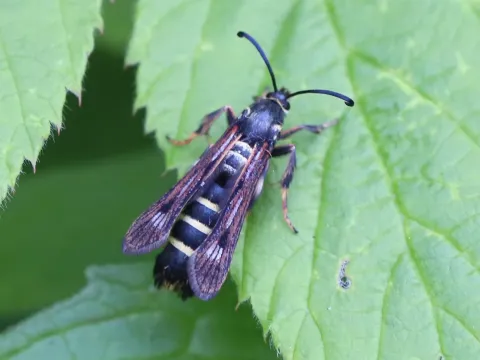
Raspberry clearwing moth
Pennisetia hylaeiformis
The raspberry clearwing moth (Pennisetia hylaeiformis) is a moth in the Sesiidae family. Adults mimic wasps or hornets, featuring a black body with yellow cross-bands and transparent wings with narrow dark margins.
What the section contains
Raspberry clearwing moth
Adults have a wingspan ranging from 20 to 30 mm. The body is covered with dense hairs, and the tip of the abdomen possesses a characteristic tuft of scales, which is a classic feature of the Sesiidae family.
The larvae are white or cream-colored with brown heads, reaching up to 30 mm in length. These larvae are responsible for the damage as they bore into the plant stems and roots.
The life cycle of the moth typically spans two years. During this period, the insect progresses through the egg, larval, pupal, and adult stages, successfully overwintering within the stems of the host plant.
Adult moths are typically active during the summer months, with peak emergence often coinciding with the early to mid-summer period, when raspberries are in full growth.
The primary hosts for this pest are raspberries (Rubus idaeus), though it can occasionally infest blackberries. Larvae cause damage by boring galleries inside the stems and the root crown.
This feeding activity disrupts the transport of water and nutrients, leading to the weakening of the plant. Infested canes often become stunted, lack vigor, and are prone to breakage under stress.
Infestations can significantly reduce berry yields by up to 50% in severe cases, as the larvae physically compromise the structural integrity of the plant's vascular system.
Persistent infestations weaken the root system of the raspberry bush, making it more susceptible to secondary pathogens, fungal infections, and winter damage.
Because the damage is internal and hidden within the stems and roots, infestations are often not detected until the bush begins to wilt or die, making control difficult.
One of the most reliable signs of infestation is the appearance of distinct swellings or galls at the base of the stems, just above the soil line where the larva has tunneled.
During the spring, affected plants often show delayed or uneven development. These canes may appear chlorotic, with leaves turning yellow or wilting prematurely compared to healthy specimens.
Upon closer inspection, the affected canes may show cracks or holes in the bark near the base, which serve as entry or exit points for the larvae or emerging adults.
If an infested stem is cut open, the core will reveal longitudinal galleries filled with frass, which are the larval droppings, indicating the presence of the pest.
In late spring, empty pupal casings may be found protruding from the exit holes on the stems, confirming that adult moths have emerged and that the cycle is continuing.
The first line of defense is strict sanitation. All canes showing signs of swelling or wilting should be pruned close to the ground and destroyed, preferably by burning, to kill larvae.
Regular monitoring using pheromone traps during the flight period is an effective way to track the population density and determine the timing for necessary interventions.
When selecting new planting material, it is crucial to inspect the root crown and base of the canes for any signs of galls, ensuring that the infestation is not introduced to the garden.
Chemical control can be difficult due to the larvae's protected position within the stems. If insecticides are used, they must be applied according to local regulations and strictly timed.
- Avoid leaving old stumps in the ground after pruning as they may harbor larvae.
- Maintain plant vigor through proper fertilization and watering.
- Remove any wild brambles near the planting site that could serve as alternative hosts.
- Biological control using entomopathogenic nematodes or fungi may be an option in integrated programs.