
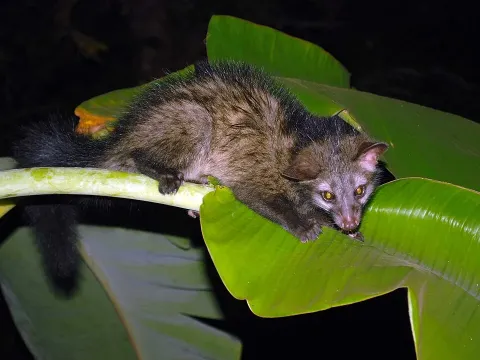
Asian palm civet
Paradoxurus niger
The Asian palm civet (Paradoxurus hermaphroditus) is a mammal belonging to the family Viverridae, order Carnivora. It is a small, nocturnal animal with an elongated body covered in coarse, greyish-brown fur marked with distinctive black stripes or spots along the back.
What the section contains
Asian palm civet
Equipped with sharp claws, this animal is highly adapted to an arboreal lifestyle, allowing it to navigate through tree canopies with ease. Typically reaching about 50 centimeters in body length with a tail of similar size, it uses its acute sense of smell to locate the ripest fruits on coffee trees.
The biology of the Asian palm civet is deeply integrated into tropical ecosystems, where it functions both as a consumer of vegetation and a potential agricultural pest. Individuals are territorial and prefer to dwell near reliable food sources, which makes coffee plantations highly attractive habitats.
Breeding occurs throughout the year, with activity peaks often coinciding with the mass ripening of fruit. Females seek shelter in secluded areas, such as hollow trees or abandoned buildings located on the periphery of agricultural lands, to raise their young.
While the species is famous for its role in producing the specialized "Kopi Luwak" coffee, from an agronomic perspective, the palm civet is viewed as a persistent consumer that reduces marketable yield by feeding on high-quality coffee cherries.
The primary food source for the Asian palm civet on plantations is the fruit of coffee plants (Coffea arabica and Coffea canephora). The animals exhibit a strong preference for the ripest, highest-quality cherries, causing direct losses to the harvest.
In addition to coffee, these civets act as polyphagous pests capable of damaging other tropical crops, including papaya, mango, bananas, and sapodilla. This diet versatility allows them to maintain high population numbers even during the off-season for coffee.
Damage is characterized not only by the consumption of fruit but also by mechanical breakage of branches as the animals navigate the canopy. Intense feeding results in a significant reduction in the quantity of sellable beans and necessitates extra labor for sorting during post-harvest processing.
In agricultural regions, high population densities of palm civets can lead to yield losses ranging from 10% to 15% per season. Their habit of returning to the same productive trees year after year makes them a consistent threat to plantation profitability.
Although they are not insectivores, their presence requires a shift in farm management strategies, as standard chemical insect control has no effect on them, and direct lethal control is often restricted by wildlife conservation laws.
The activity of the Asian palm civet is closely tied to the phenological stages of coffee cherry maturation. Population concentration in plantation areas is highest during the harvest season when the berries reach peak sugar content.
Unlike many insect pests, the palm civet is active year-round, but its negative economic impact on farms peaks during the autumn and winter months, which correspond to the main harvest period in tropical coffee-growing regions.
Its nocturnal lifestyle dictates the timing of its presence: the animals emerge to forage after sunset, making visual monitoring and rapid response by farmers difficult to execute during the night.
Seasonality is also linked to climatic variables: in rainy seasons, civets may become less active in exposed areas, seeking more permanent cover, while dry weather encourages increased movement and foraging across the plantation.
To monitor population levels, it is recommended to employ camera trapping and nocturnal observation techniques prior to the harvest season, which allows for the assessment of potential risk before the cherries begin to ripen significantly.
The primary indicator of a palm civet's presence is the discovery of partially eaten cherries beneath trees or unique fecal droppings containing undigested coffee beans. Such findings are clear evidence that the area is being utilized as a foraging site.
Another sign includes tooth marks on the skin of the fruit. Frequently, broken young shoots can be found on branches that could not support the animal's weight as it navigated toward the top of the tree to reach the best berries.
- Presence of scat containing coffee seeds.
- Fresh claw marks on the bark of coffee tree trunks.
- Damaged and partially fallen berries scattered on the ground.
- Specific vocalizations or rustling noises in the canopy during the night.
Experienced agronomists also note the absence of other wildlife signs typically associated with rodents or birds, as the palm civet exhibits behavior consistent with a larger, dominant nocturnal predator.
Routine scouting of plantations during early morning hours allows for the rapid identification of these "signatures," enabling the implementation of preventative measures before the bulk of the harvest is compromised.
Physical barriers are the most effective method for protection. Installing metal collars around the trunks of coffee trees prevents the animals from climbing into the canopy where the ripe fruit is located.
The use of light-based deterrents that mimic the presence of predators or cause discomfort during the night can effectively reduce the frequency of visits to the plantation, although animals may eventually habituate to static light sources.
Agronomic practices include cleaning up fallen fruit from between rows, which attracts civets, and clearing undergrowth that serves as daytime hiding spots for the animals.
Biological control involves the conservation of the palm civet's natural predators in adjacent forest zones, which helps maintain population balance and limits excessive growth of the pest population on agricultural lands.
An important aspect of management is community engagement and the integration of farms into biodiversity management programs, where compensation for crop damage is balanced against the value of sustainably produced and wildlife-friendly coffee products.