
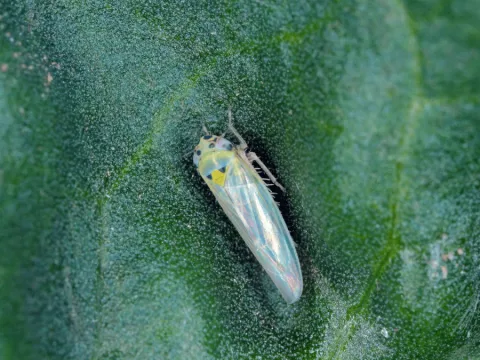
Aster leafhopper
Macrosteles fabae
The Aster leafhopper (Latin: Macrosteles fabae) is a small insect belonging to the order Hemiptera and the family Cicadellidae. Adults are approximately 3–4 mm long and typically exhibit a pale green or yellowish coloration.
What the section contains
Aster leafhopper
The insect possesses an elongated body structure and strong hind legs, allowing it to jump or fly away rapidly when disturbed, making it a very agile field pest.
The life cycle consists of the egg stage, five nymphal instars, and the adult stage. Eggs are inserted into the plant tissue by the female, which protects them until they hatch.
Depending on local climatic conditions, the Aster leafhopper can complete several generations throughout the growing season, with populations often peaking in mid-summer.
Overwintering typically occurs as eggs laid within the stems of perennial grasses and weeds, which allows the species to survive the cold months and colonize crops early in spring.
This pest is highly polyphagous and infests a wide range of agricultural crops, including legumes, cereals, carrots, potatoes, and various leafy vegetables.
Damage is caused both by direct feeding, where the insect extracts sap from the plant, and by the transmission of serious plant diseases, most notably Aster Yellows.
By injecting saliva while feeding, the leafhopper introduces phytoplasmas into the host plant, which significantly impairs the plant's metabolic processes and growth.
Severe infestations often result in stunted growth, leaf curling, chlorosis, and in many cases, a complete failure of the plant to produce a marketable crop.
Young plants are particularly vulnerable, and high leafhopper populations at the emergence stage can necessitate significant replanting efforts for the affected fields.
The initial signs of an infestation include the curling and yellowing of leaf edges, which later turn reddish or brown as the damage progresses and the tissue dies.
Plants often exhibit a characteristic stunted appearance, with internodes becoming shorter and leaf development appearing deformed or abnormally clustered.
In cases of viral or phytoplasma infection spread by the leafhopper, leaves show distinct yellowing (chlorosis) or reddening, which often starts from the leaf margins.
When walking through an infested crop, a sudden cloud of small insects taking flight is a primary indicator of high leafhopper density and an urgent need for intervention.
Affected fields may appear patchy, with plants showing different stages of decline and discoloration, leading to reduced overall biomass and poor crop quality.
Integrated Pest Management (IPM) is essential for controlling the Aster leafhopper, focusing on a combination of cultural, biological, and chemical strategies.
Sanitation plays a critical role; removing weeds around field borders helps eliminate the primary reservoirs for the leafhopper and the diseases it transmits.
Systemic insecticides are commonly applied when population thresholds are exceeded, ensuring that the crop is protected during its most sensitive growth stages.
Biological controls, such as encouraging natural predators like lady beetles and lacewings, can help suppress leafhopper populations without relying solely on synthetic chemicals.
- Early planting to avoid peak migration periods of the insects.
- Use of yellow sticky traps for monitoring population trends in the field.
- Regular scouting of crops to assess damage levels and timing treatments.
- Post-harvest tillage to destroy overwintering sites in crop debris.