
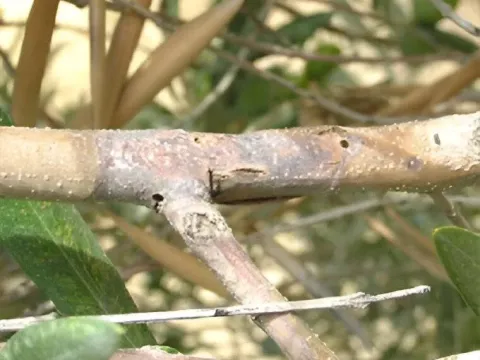
Olive bark beetle
Hylesinus vestitus
The olive bark beetle (Hylesinus vestitus) is a small beetle belonging to the Curculionidae family and Scolytinae subfamily. Adults are typically 2.5 to 3.5 mm in length, possessing a dark, robust body covered in fine, greyish-brown scales and hairs.
What the section contains
Olive bark beetle
The larvae are white, legless grubs with a brownish head capsule. They spend their entire developmental cycle beneath the bark or within the woody tissue of olive branches, which provides them with environmental stability and protection.
The taxonomic classification places this species within the order Coleoptera. Their morphology and biology have evolved to allow them to exploit the dense woody stems of the Olea europaea plant efficiently.
Detection is difficult due to their cryptic habits. Often, the presence of the pest is only noticed when the cumulative damage to the olive tree's vascular system becomes visually apparent through crown decline.
Recognizing the adult beetle's size and color, as well as the unique pattern of its galleries, is crucial for any orchard management program aimed at keeping the olive trees healthy and productive.
This beetle primarily affects olive trees, focusing its damage on the young shoots and branches. Both adults and larvae contribute to the harm, as they feed on the inner bark and phloem layers of the plant.
By boring into the wood, the beetles disrupt the tree's vascular system. This interference prevents the normal transport of water and nutrients, which ultimately leads to the wilting and eventual necrosis of the affected branches.
In addition to physical damage, the galleries created by the beetles serve as entry points for secondary fungal and bacterial pathogens, which can cause systemic infections and further weaken the entire tree.
Severe infestations reduce fruit production significantly. Since olives are the main product of the tree, the economic loss resulting from branch dieback and decreased tree vigor is substantial.
Persistent attacks can lead to tree death if not managed. The cumulative stress from the beetle feeding makes the olive trees more susceptible to environmental factors such as drought or heat stress.
The life cycle begins in early spring when adults emerge from their overwintering sites, typically as temperatures reach optimal levels (above 15°C). This timing is critical for planning preventative measures.
Active flight and colonization of new branches continue throughout the growing season. In warmer climates, the olive bark beetle can produce multiple generations per year, leading to overlapping life stages.
As the cooler autumn weather approaches, the adult population shifts toward finding suitable hiding spots in the bark, where they will hibernate until the next season's warmth signals the start of a new cycle.
Biological development is highly dependent on the host tree's condition and ambient temperature. Understanding these phenological stages is essential for predicting periods of maximum pest pressure.
Orchard monitoring during peak flight seasons helps agriculturalists decide when to intervene, ensuring that the control strategy matches the beetle's activity pattern.
The most evident sign is the presence of small entry holes on the bark surface. In many cases, these openings are accompanied by the exudation of sap or gum, which is a defensive response by the tree.
Under the bark, one can observe distinct gallery patterns. Maternal galleries usually run longitudinally along the stem, while the larval galleries radiate outward, progressively widening as the larvae develop.
Visual symptoms in the canopy include the yellowing, drying, and eventual death of the tips of young shoots. This "dieback" phenomenon is a classic indicator that the internal branch health has been compromised.
- Small, round exit/entry holes on branches.
- Gummosis or sap dripping from the bark.
- Frass (boring dust) accumulation around the base of twigs.
- Branch tip wilting and necrosis.
- Presence of larval galleries under the removed bark.
Consistent field scouting is necessary to catch infestations early, particularly after pruning operations or weather events that create stress points on the trees.
Sanitation is the cornerstone of control. All infested wood must be pruned and immediately destroyed, preferably by burning, to ensure that the larvae inside do not survive to emerge as adults.
Maintaining strong tree vigor through proper irrigation and balanced fertilization is vital. Healthy trees are much better equipped to withstand and recover from light beetle infestations.
Chemical control involves targeting the adults during their active flight period. Contact insecticides are used to treat the canopy, which can help reduce the population before extensive colonization occurs.
Pheromone-based monitoring tools are highly effective for tracking adult activity levels. This information allows growers to time their insecticide applications precisely, reducing unnecessary chemical usage.
Integrated Pest Management (IPM) practices should be employed, focusing on preserving natural predators that may inhabit the orchard and help suppress bark beetle population growth naturally.