
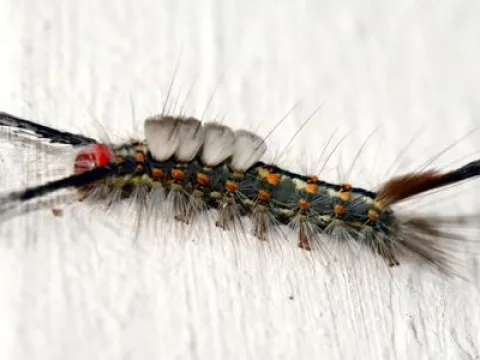
Definite Tussock Moth
Hemerocampa definita
The Definite Tussock Moth (Orgyia definita, formerly Hemerocampa definita) is a member of the Erebidae family. Adult males are brownish-gray moths, while females are flightless and typically remain near their cocoon sites.
What the section contains
Definite Tussock Moth
The larvae are easily recognized by their distinct appearance: they are covered in dense tufts of yellow or light brown hair. Four thick hair tufts, or "discs," are located prominently on their back.
Two long, forward-pointing tufts of dark hair are located near the head, resembling antennae. A mature caterpillar reaches 30 to 35 millimeters in length, making them quite conspicuous on host plants.
A key biological feature is the presence of bright glands on the 6th and 7th abdominal segments. These hairs can cause skin irritation or rashes in humans, so direct contact should be avoided during handling.
Females deposit their eggs directly onto their own cocoons, covering the mass in a frothy secretion and additional abdominal hairs. This protects the eggs from harsh environmental conditions and predators.
This pest is a generalist feeder that consumes the foliage of various deciduous trees and shrubs. Its host plants include native tree species as well as many ornamental plants grown in gardens.
Common hosts include species of maple, oak, linden, birch, and willow. In nursery settings or orchards, they may occasionally feed on fruit trees, causing noticeable damage to leaves and potentially affecting plant vitality.
Young larvae initially skeletonize the leaves, consuming only the soft tissue and leaving the veins intact. As they mature, they consume the entire leaf blade, often leading to significant defoliation of branches.
Mass outbreaks can strip entire trees of their leaves by mid-summer. This extreme defoliation stresses the host, reducing its cold tolerance and suppressing growth for the remainder of the season.
Repeated defoliation over several consecutive years can lead to branch dieback and an overall decline in tree health, making the affected trees more susceptible to secondary pests and fungal infections.
The species generally completes one generation per year, though in warmer southern climates, a second generation may occur. They overwinter in the egg stage, attached to tree bark or twigs.
Larval emergence coincides with the leaf budding of host trees, typically occurring in late spring or early summer. Newly hatched larvae begin feeding immediately on the underside of the leaves.
The peak feeding activity occurs throughout June and July. During this timeframe, larval populations increase significantly, making their presence and the associated leaf damage very evident.
Pupation takes place in late summer. Cocoons are spun within bark crevices, among leaf litter, or in the crotches of branches, where they are secured with silk to ensure stability during the transition.
Adult moths emerge in late summer or early fall. After mating, females lay their eggs, which will remain dormant on the host plant until the following spring, thus completing the annual life cycle.
Mechanical control is highly effective for small-scale infestations in home gardens. During the dormant season, inspect tree trunks and branches for egg masses and remove them manually to reduce the population.
Biological control using Bacillus thuringiensis (Bt) is an effective and environmentally friendly method for managing younger larvae without harming beneficial insects like bees and pollinators.
For severe infestations, chemical insecticides, such as pyrethroids, can be applied. It is essential to time applications during the period when caterpillars are actively feeding to achieve maximum efficacy.
Encouraging natural predators such as birds (chickadees, nuthatches) and parasitic wasps is a sustainable long-term strategy, as they significantly reduce larval and egg populations naturally.
Routine maintenance, including pruning damaged branches and clearing debris where cocoons might hide, is a critical preventive measure to minimize the risk of recurring infestations in your landscape.