
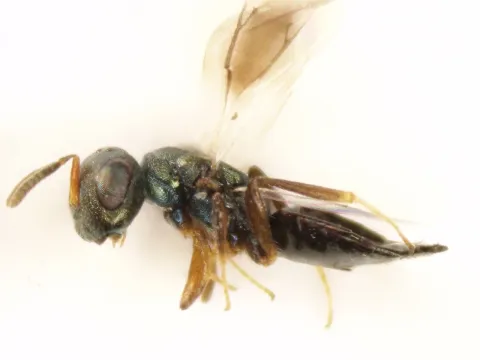
Dibrachys
Dibrachys boucheanus
Dibrachys boucheanus is a minute insect from the order Hymenoptera, belonging to the Pteromalidae family. Adult individuals are tiny parasitic wasps with a distinct metallic sheen on their bodies.
What the section contains
Dibrachys
The body length of the imago typically ranges from 2 to 3 millimeters. The color is predominantly dark, varying from bronze-green to almost black, allowing the insect to remain unnoticed in packaging folds or grain mass.
The wings are transparent with minimal venation, typical for most Pteromalidae representatives. The head is large, with well-developed mandibles that females use to bore through the host pupa's casing.
Larvae of Dibrachys boucheanus lead a parasitic lifestyle. They are legless, whitish or cream-colored, and develop directly inside or on the host's body, consuming its internal tissues completely.
Identification in the field is difficult due to their microscopic size. Agronomists rely on laboratory analysis methods and binocular microscopes for accurate classification of the species.
This species is a specialized parasite that attacks a wide range of harmful insects. In an agronomic context, it is most dangerous in storage facilities as it damages beneficial entomophages, limiting the natural population control of pests.
Its targets include pupae and larvae of various Lepidoptera and Coleoptera found on grain crops and stored products. It is a known pest of barns and storage warehouses.
Secondary damage involves destroying populations of the pests' natural enemies. If this parasite targets beneficial insects used in biological control, it leads to a sharp increase in the primary agricultural pest populations.
Damage occurs both to seeds in storage rooms and to plant debris in fields where host pupae may hibernate. This makes it a significant link in the ecosystem, often acting against agronomic interests.
The damage manifests as an indirect reduction in field productivity due to the imbalance of entomofauna. In storage conditions, it can breed actively if the substrate contains a high density of host individuals.
The life cycle of Dibrachys boucheanus is closely linked to the phenology of its hosts. In closed facilities and silos, the insect can develop almost year-round if stable temperatures are maintained.
Outdoors, activity begins with the onset of sustained warm temperatures in spring, when the first generations of hosts emerge from diapause. Peak activity is observed in mid-summer and early autumn.
Reproduction is rapid, as several generations can occur within a single season. This allows the pest to increase its population density quickly under favorable environmental conditions.
The species hibernates primarily in the pre-pupa or pupa stage inside host cocoons or plant debris. In heated warehouses, diapause may be absent, which accelerates population buildup.
Climatic factors are critical: air humidity directly determines larval survival. Optimal conditions promote massive emergence of adults during the grain ripening period.
Signs of presence are detected through careful inspection of infested host pupae. A characteristic indicator is the presence of small holes in the cocoon shell, through which the adults emerge.
Upon dissecting damaged host individuals, one may find clusters of white larvae or evidence of their activity inside the body. Externally, the host pupa may appear shriveled or hollow.
A decrease in the effectiveness of biological control agents against pests can also serve as an indirect indicator of the parasite's activity. If entomophages are dying in large numbers, storage facilities should be checked for this pest.
The presence of large numbers of small black insects in storage rooms near grain storage sites is a clear signal of an active life cycle for this species.
Sieve analysis of grain samples often allows for the detection of imagoes, which provides direct evidence of the batch being infested by this parasite.
The primary control method is strict adherence to sanitary and hygienic standards in storage facilities. Regular cleaning of granaries from dust, grain residues, and vegetable debris minimizes hibernation sites.
Fumigation of premises is effective in destroying both the pests and their hosts. It is crucial to conduct treatment in accordance with pesticide regulations for specific types of storage units.
Controlling grain moisture is a key factor in limiting reproduction. Dry grain is less attractive for the establishment of stable parasite populations and their victims.
In field conditions, effective methods include stubble destruction and deep plowing, which disrupts the habitats and hibernation sites of the pupae that this parasite depends on.
- Using airtight containers for seed storage.
- Monitoring temperature and humidity inside grain silos.
- Biological control by restricting the import of infested product batches.