
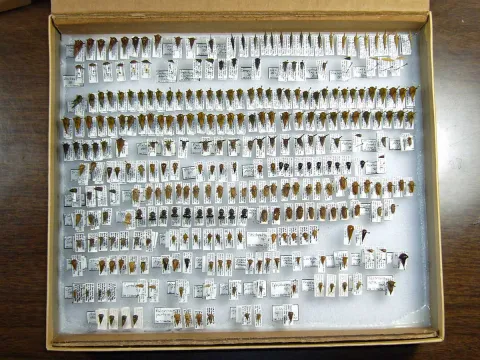
Decorative treehopper
Vanduzeea decorata
The decorative treehopper (Vanduzeea decorata) belongs to the order Hemiptera and the family Membracidae. These small insects are characterized by a prominent, often thorn-like pronotum that extends over the abdomen, providing excellent camouflage against plant stems.
What the section contains
Decorative treehopper
Adults typically measure between 5 and 7 millimeters in length, exhibiting a brown or mottled coloration that blends seamlessly with the bark of trees and shrubs, making them difficult to detect by the naked eye.
Nymphs lack the developed pronotal horn of the adults and often appear as flattened or elongated stages, frequently covered in waxy secretions that protect them while they feed in clusters.
Vanduzeea decorata exhibits a strong mutualistic relationship with ants, which protect the treehoppers from predators and parasitoids in exchange for the honeydew the insects excrete while feeding.
Reproduction involves laying eggs into the plant tissue. Females use their specialized ovipositors to insert eggs directly into the bark of young twigs or leaf petioles, often creating visible scars in the process.
These insects primarily target members of the Fabaceae family, such as acacia, but they can be found on a variety of woody plants and ornamentals, where they extract plant sap using their piercing-sucking mouthparts.
Continuous feeding by nymphs and adults drains the plant's resources, leading to reduced vigor, stunted growth of young shoots, and potential yellowing of foliage in heavily infested areas.
The oviposition process causes structural damage to twigs, creating entry points for secondary pathogens and causing localized necrosis that can result in the dieback of small branches.
The accumulation of honeydew on foliage promotes the growth of sooty mold, a fungus that covers leaves in a black, powdery layer, which significantly inhibits photosynthesis and weakens the overall health of the plant.
In cases of severe infestation, the cumulative stress on the plant can lead to significant leaf drop and deformity of new growth, drastically reducing the aesthetic and commercial value of the affected trees.
Activity begins in the spring as soon as weather conditions allow for egg hatching, with the first generation of nymphs emerging to feed on the tender, new spring growth of host plants.
Population density typically peaks during the mid-summer months when multiple generations have matured, taking advantage of the high availability of nutrient-rich sap in the plants.
Throughout the growing season, continuous monitoring is essential, as the species can complete several reproductive cycles, ensuring that nymphs and adults are present simultaneously on host plants.
As autumn approaches and temperatures drop, the activity of adults gradually declines as they seek suitable sites, such as bark crevices or dry leaf litter, to overwinter and survive the colder months.
The timing of these seasonal events is highly dependent on local climate and environmental factors, which can either accelerate or delay the development cycles of the treehopper population.
The most reliable sign of a treehopper presence is the frequent attendance of ants on the plant, as they are drawn to the honeydew produced by the treehopper colonies.
Careful inspection of young stems will reveal characteristic longitudinal scars or slits in the bark, indicating where females have laid their eggs during the current or previous season.
The presence of sticky honeydew on the leaves below the infestation site is a clear indicator of feeding activity and often serves as a precursor to the development of sooty mold.
Disturbing the branches will often cause adults to suddenly jump away, which is a defensive mechanism and a primary way to identify them when they are not easily visible against the plant background.
Visible decline in the condition of new shoots, including twisting or darkening of the stems, serves as a late-stage sign that the treehopper population has reached a level requiring intervention.
Effective control starts with mechanical removal, such as pruning away infested twigs that contain egg clusters during the dormant or early growth season to reduce future populations.
Implementing sticky bands around the trunks of trees can disrupt the ant-treehopper mutualism, leaving the nymphs vulnerable to natural predators and significantly lowering their survival rates.
When necessary, systemic insecticides may be applied to provide long-lasting control, as they are ingested by the treehoppers while they consume the sap of the treated plant.
- Utilize yellow sticky traps to monitor and catch mobile adults.
- Maintain good horticultural practices to ensure plants are less susceptible to stress.
- Encourage natural enemies like lady beetles and lacewings in the garden.
- Avoid broad-spectrum pesticide use that could harm beneficial predatory insects.
It is crucial to approach management with an integrated pest management (IPM) strategy, prioritizing cultural and biological controls before resorting to chemical interventions.