
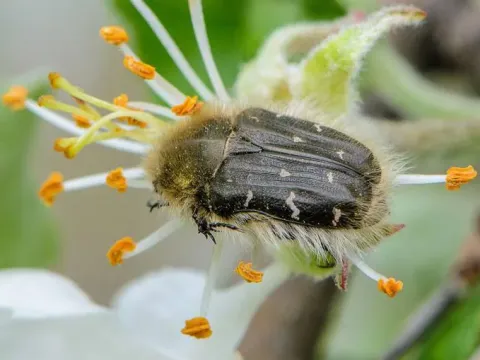
Shaggy rose beetle
Epicometis
The shaggy rose beetle (Epicometis hirta) is a member of the Scarabaeidae family, recognizable by its compact body and dense greyish hair covering its dark exoskeleton.
What the section contains
Shaggy rose beetle
Adult beetles measure between 9 and 13 mm in length and possess distinct white spots on their elytra, which serve as a primary visual identification marker.
Larvae are typical white grubs that develop underground, feeding on decaying organic matter and roots, which generally distinguishes them from the foliage-damaging adults.
They overwinter as adults within the soil and emerge when spring temperatures rise, typically starting their flight activity once the air warms up to 15°C.
These beetles are highly active fliers and are attracted to open flowers, where they aggregate in large numbers during the peak of their seasonal activity.
This beetle is a significant pest of fruit trees, including apples, pears, plums, and cherries, focusing its damage on the reproductive parts of the blossoms.
Beyond orchard trees, it severely damages various berry bushes like strawberries and raspberries, as well as many ornamental garden flowers like roses and tulips.
Adults feed voraciously on stamens, pistils, and petals, effectively destroying the floral structures and preventing the development of fruit or seeds.
The economic impact can be devastating, as a large infestation can strip a blossoming tree of its entire fruit production potential within just a few days.
The sheer number of beetles congregating on a single flower or cluster often leaves the host plant completely unable to recover its reproductive capacity for the season.
The emergence of the shaggy rose beetle is highly synchronized with the early spring flowering period, occurring between late March and June.
Peak activity is observed during April and May, coinciding with the prime blooming stage of most temperate fruit and berry crops.
The beetles are diurnal, showing maximum activity on sunny, warm days, while seeking shelter in the soil or under vegetation during cooler or overcast weather.
The entire duration of their damaging phase lasts about two months, directly covering the critical pollination and flowering window for most crops.
As flowering ends, the beetles move back into the soil to mate and lay eggs, marking the transition from their adult feeding phase to the next generation's life cycle.
The most immediate sign of an infestation is the visual presence of dark, hairy beetles inside the flower cups, often moving actively around the bloom.
Flowers infested by the beetles will show shredded petals, chewed-off stamens and pistils, and general structural degradation of the floral organs.
Affected blossoms turn brown, wilt, and drop off prematurely, leading to a noticeable thinning of the canopy's expected fruit set.
A heavy infestation causes the entire tree to look devastated, with a high concentration of dead, skeletonized flowers remaining on the branches.
Farmers often notice damage beginning on early-blooming weeds like dandelions before the beetles move onto the primary orchard trees.
Mechanical control, such as placing blue-colored water traps around the orchard, is highly effective because these beetles have a strong preference for the color blue.
Manual shaking of branches over tarps early in the morning, when beetles are sluggish, can significantly reduce the population in small home gardens.
Chemical control is complicated by the presence of pollinators; therefore, using systemic insecticides during bloom is strictly discouraged to protect honeybees.
Autumn and spring soil cultivation helps disturb the overwintering adults and reduces the success rate of the next generation's development.
- Use of blue light or water traps to capture adults.
- Manual collection and destruction in early morning.
- Cultivating soil to disrupt beetle overwintering sites.
- Use of botanical repellents that do not harm bees.
- Monitoring early-blooming indicator plants for arrival.