
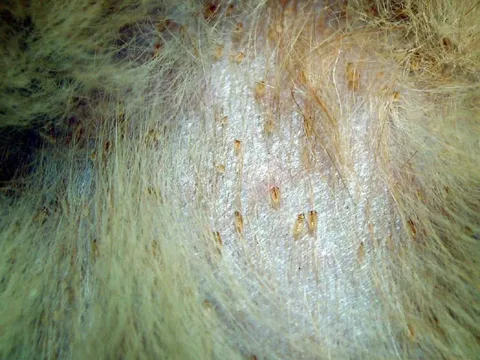
Sheep biting louse
Damalinia ovis
The sheep biting louse (Damalinia ovis) is a small, wingless insect belonging to the order Mallophaga and the family Trichodectidae. It is a highly host-specific ectoparasite.
What the section contains
Sheep biting louse
Measuring about 1.5 mm in length, the louse has a flattened, yellowish-brown body with dark transverse bands. It possesses a wide head equipped with mandibles designed for chewing.
Unlike sucking lice, the biting louse feeds on skin debris, surface secretions, and wool fibers. It does not penetrate the skin to consume blood, but its feeding habits cause significant irritation.
The entire life cycle occurs on the sheep. Females attach eggs, known as nits, to the wool fibers near the skin. Development from egg to adult takes approximately three to four weeks.
These insects are highly sensitive to environmental changes. They cannot survive for more than a few days away from the host, so transmission relies primarily on direct animal-to-animal contact.
The primary damage caused by D. ovis is economic, resulting from wool degradation and reduced animal productivity due to constant irritation and discomfort.
The persistent itching leads sheep to rub against fences, posts, and feeders. This behavior causes significant breakage of wool fibers, matted fleece, and patches of hair loss.
The skin becomes inflamed and traumatized by constant scratching. This damage decreases the quality and market value of the wool, often leading to it being downgraded.
In addition to fleece damage, the intense irritation causes chronic stress. This negatively impacts the feed conversion ratio, leading to weight loss and reduced growth rates in lambs.
Secondary infections may occur if the damaged skin becomes infected by bacteria. Severe infestations can severely compromise the animal's overall immune status and health.
While biting lice can persist throughout the year, their populations typically reach peak levels during the autumn and winter months, particularly in housed flocks.
The close physical proximity of sheep in barns or sheds facilitates the rapid spread of lice throughout the group. High humidity and stable temperatures promote optimal breeding conditions.
During the warmer months, populations may decline on the pasture due to environmental stress, such as direct sunlight and heat, which are less favorable for louse survival.
However, the parasite does not disappear entirely. Residual populations remain in the wool, ready to proliferate rapidly once the animals return to confinement or environmental conditions improve.
Seasonal management is crucial, as the increased density of sheep during winter storage makes this the most critical period for population explosions if control measures are ignored.
The most obvious clinical sign of infestation is the sheep's behavior: excessive scratching, rubbing, and biting at affected areas of the body to alleviate itching.
Visual examination reveals localized areas of frayed, matted, or missing wool. The fleece may appear ragged, and large patches of bare skin may be visible in severe cases.
Upon parting the wool, one can observe the lice moving quickly over the skin. They often congregate near the base of the wool fibers and avoid direct light.
Nits (eggs) appear as tiny, white, pear-shaped objects glued firmly to the individual hair shafts. They are resilient and difficult to remove by grooming or brushing.
Excessive skin flaking, resembling dandruff, is a common indicator of a heavy louse load, as the insects constantly disturb and consume the epidermal layer.
Effective control involves the application of registered insecticides. Common formulations include pour-on products, sprays, or immersion dips, often using pyrethroids or macrocyclic lactones.
For successful eradication, all sheep in the flock must be treated simultaneously. Treating only symptomatic animals usually fails to eliminate the parasite from the herd.
Environmental sanitation is essential. Cleaning and disinfecting housing areas, particularly rubbing posts or fences, helps prevent the reintroduction of lice from the environment.
Adopting strict biosecurity practices, such as quarantining and treating new additions to the flock, is the most effective way to prevent the introduction of D. ovis.
Regular monitoring, especially during the autumn before housing, allows producers to detect and manage infestations before they become widespread and impact wool quality.