
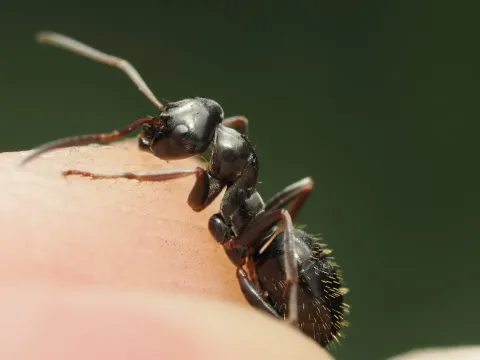
Shiny black ant
Formica gagates
The shiny black ant (Formica gagates) belongs to the Formicidae family within the Hymenoptera order. They are easily identified by their deep black, highly polished, and glossy exoskeleton.
What the section contains
Shiny black ant
Unlike other common species, their bodies are noticeably smooth and lack dense hair cover, which gives them a distinct appearance.
Workers range from 4 to 6 mm in length, while the queen is significantly larger. These ants are known for their fast movement and robust social structure.
They prefer nesting in soil under stones, decaying timber, or near the root zones of trees, making them a common sight in orchard environments.
Their colony development is highly resilient, and they maintain a disciplined workforce capable of complex foraging tasks across the garden.
The primary concern regarding these ants is their symbiotic relationship with aphids. They actively protect aphid colonies from natural predators such as ladybugs.
By preventing predators from reaching the aphids, the ants ensure that the aphid population multiplies, causing severe stress to the host plants.
The honeydew produced by aphids is collected by the ants and encourages the growth of sooty mold, which blocks sunlight and hinders photosynthesis.
The ants facilitate the spread of aphids to new, healthy shoots, effectively accelerating the infestation process throughout the entire garden.
While direct damage to plants is minimal, their tunneling activities near sensitive root systems can cause secondary wilting and nutrient uptake issues.
The most reliable sign of their presence is a continuous line of ants patrolling up and down the trunks of fruit trees and berry bushes.
Visible colonies of aphids accompanied by ants are a clear indicator of a mutualistic relationship operating on your plants.
Sticky residue on leaves (honeydew) and the subsequent appearance of black, powdery mold are symptomatic of an advanced aphid-ant infestation.
Small soil mounds around the base of trees or under decorative landscaping rocks signal the presence of a nearby nest or satellite colony.
General plant decline, yellowing leaves, and reduced shoot growth are often observed where these ants have established a strong presence.
The most effective strategy involves using toxic baits that workers transport to the nest, ultimately eliminating the queen and collapsing the colony.
Applying sticky adhesive bands or specialized tree barriers acts as a physical deterrent, preventing ants from reaching the aphid colonies on the canopy.
Controlling the aphid population is essential; using systemic insecticides to eliminate the aphids removes the food source for the ants.
Cultural practices, such as removing debris and rocks near trees, can discourage ants from establishing nests in high-traffic garden areas.
- Application of specialized ant baits or gels.
- Installation of trunk barriers/sticky traps.
- Targeted treatment of aphids with organic or chemical insecticides.
- Regular soil cultivation around the base of vulnerable plants.